





ServiceNow Knowledge 2026 arrived this week in Las Vegas in full spectacle mode: 25,000 attendees, three days of AI messaging, a keynote packed with bold claims about the future of enterprise software – and an afterparty featuring Idris Elba and the Backstreet Boys.
CEO Bill McDermott took to the stage, coming out swinging, calling ServiceNow “the fastest growing enterprise software company at scale the world has ever known” before announcing that the company plans to “once again double the size of this company in the next few years.”
He went on to declare that “everything changes” at this next stage of enterprise AI.
“We’re at an inflection point in this industry. We’re at the point where everything changes,” he told the Knowledge crowd.
That message was everywhere across the event. The keynote leaned heavily into the idea that AI alone is becoming commoditized, while orchestration, governance, and execution are becoming the real differentiators.
McDermott repeatedly referenced the “AI blind spot”, with enterprises racing to deploy agents without visibility, controls, or auditability.
But according to McDermott, “Chaos has an answer.” The company weaved that idea through nearly every major announcement unveiled so far at the event – from AI Control Tower and Action Fabric to Otto and the expansion of Autonomous Workforce.
Knowledge 2026 may end with “I Want It That Way” echoing around the Sphere, but ServiceNow’s message this week has been about doing AI in its own way, with a vision built around AI Control Tower, autonomous workflows, and the rise of the agentic enterprise.
So, what has ServiceNow announced so far?
1. AI Control Tower Gets a Major Upgrade
AI Control Tower was already a central pillar of ServiceNow’s AI story, but at Knowledge 2026, it became the main governance engine for the “agentic business”.
The upgraded AI Control Tower is designed around five dimensions: Discover, Govern, Secure, Observe, and Measure. That means identifying AI assets across the enterprise, assessing risk, monitoring runtime behaviour, securing AI identities, and tracking ROI. ServiceNow also announced 30 new enterprise integrations across AWS, Google Cloud, Microsoft Azure, SAP, Oracle, and Workday.
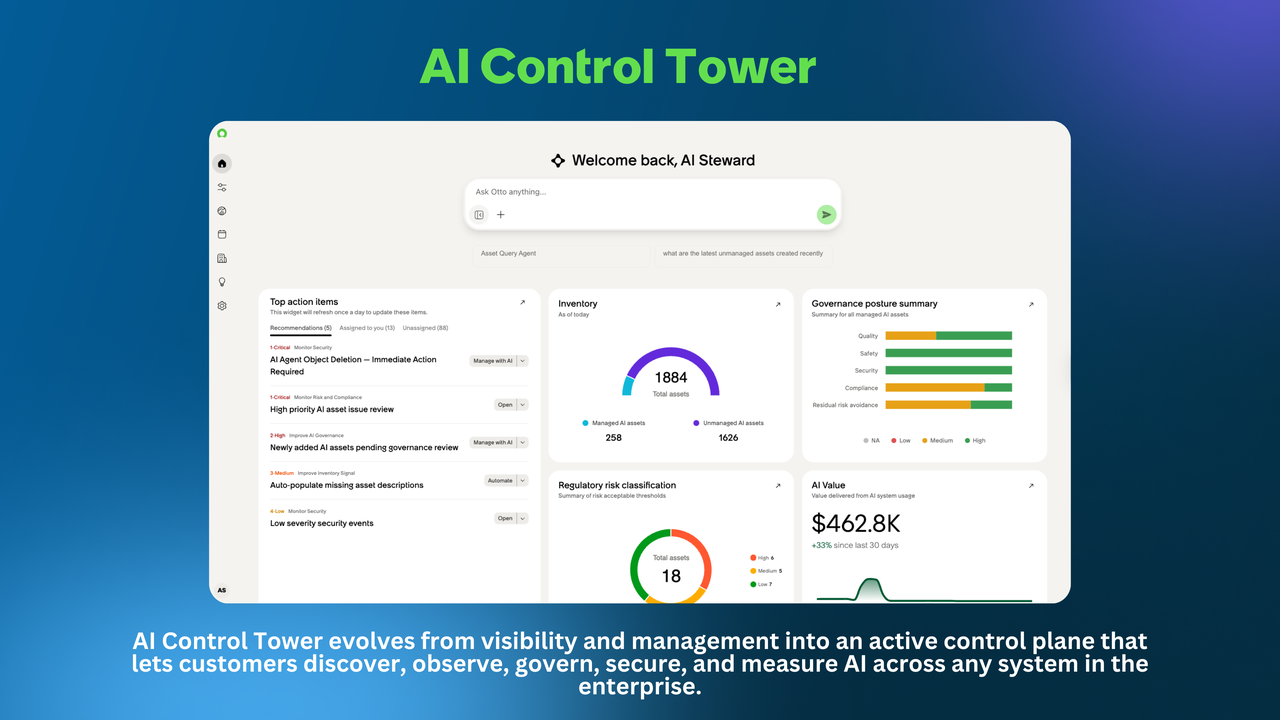
The key message is that ServiceNow does not just want to help enterprises deploy AI agents – it wants to help them control them.
2. Veza and Armis Power ServiceNow’s Security Push
It was clear at Knowledge that ServiceNow’s acquisitions of Veza and Armis are now part of its wider AI governance strategy.
Veza brings access graph technology, permissions visibility, and least-privilege enforcement to AI Control Tower, while Armis extends visibility into IT, OT, and IoT environments, as well as medical devices and critical infrastructure. ServiceNow also announced Autonomous Security & Risk, positioning it as an AI-powered security and risk platform for governing every AI agent, identity, and connected asset.
This tied directly into McDermott’s “AI chaos” warning: as enterprises deploy more agents, they also create more identities, permissions, and attack surfaces.
3. ServiceNow Launches Action Fabric
One of the most important announcements was ServiceNow Action Fabric, which opens the platform’s “system of action” to third-party AI agents.
In simple terms, external agents will be able to trigger workflows, playbooks, approval chains, service catalog actions, and business rules inside ServiceNow’s governed environment.
Anthropic is one of the first launch partners, with Claude Cowork connecting directly to Action Fabric. ServiceNow says every action triggered through Action Fabric will run through AI Control Tower, making it identity-verified, permission-scoped, and auditable.
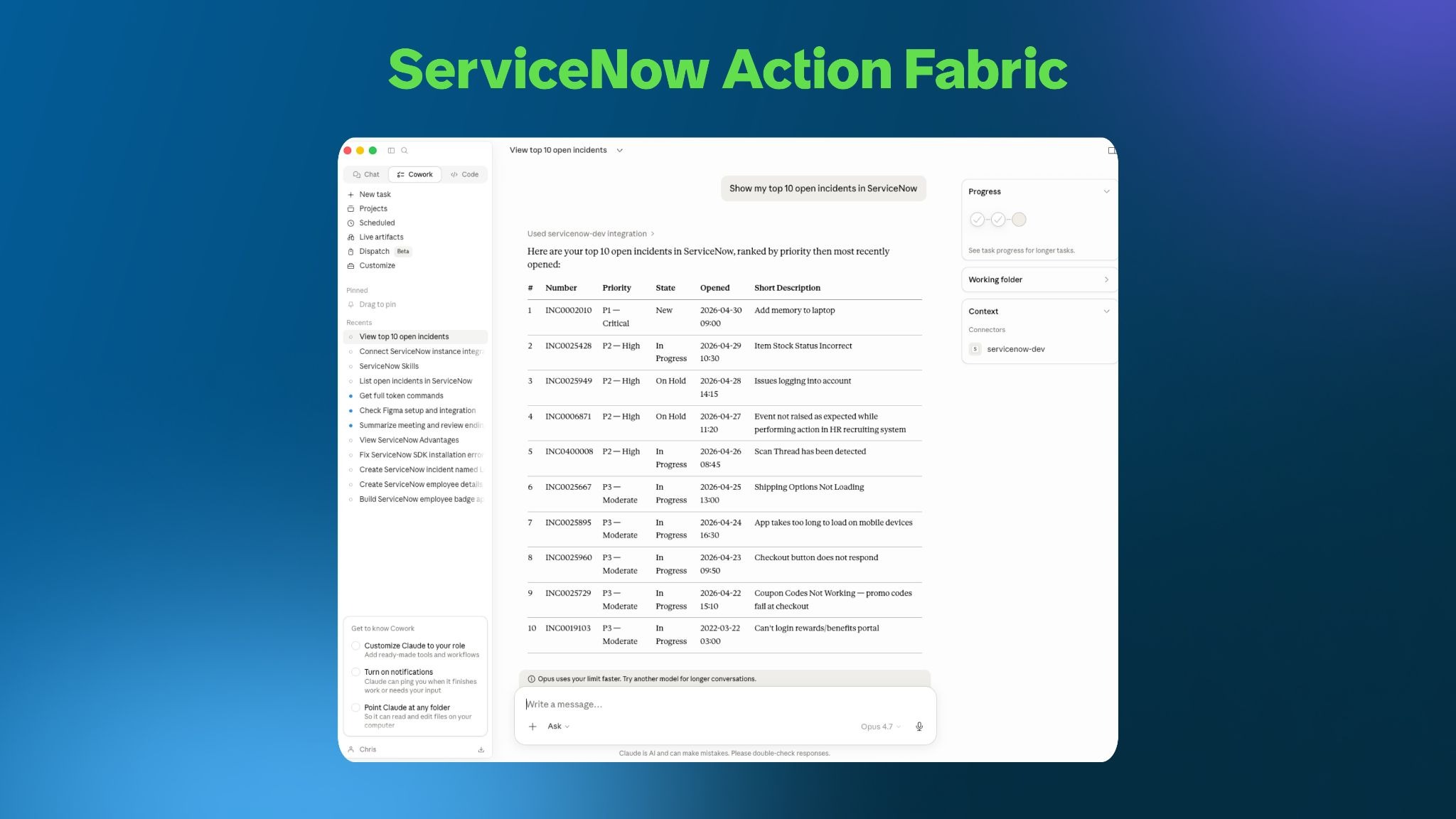
ServiceNow’s chief product officer and chief operating officer, Amit Zavery, noted in the keynote: “Data alone doesn’t run a business. Action does.”
4. Otto Becomes the New AI Front Door
ServiceNow Otto is another headline launch, bringing together Now Assist, Moveworks, and ServiceNow’s broader AI experience into one interface.
Otto is being positioned as more than a chatbot. It’s intended to turn user intent into completed enterprise work across systems, workflows, approvals, and agents. In the most basic terms, users ask for something – Otto handles it.
This links to the Action Fabric launch – employees interact through Otto, and agents connect through Action Fabric. And everything runs through ServiceNow’s governed workflow layer.
5. Autonomous Workforce Expands Across the Enterprise
ServiceNow also announced a major expansion of Autonomous Workforce, its role-specific AI specialists.
The original L1 Service Desk AI Specialist is now being joined by specialists across CRM, employee service, IT, security, and risk. These are designed to act like autonomous team members with defined roles, permissions, and audit trails.
ServiceNow says the aim is to move beyond “advisory AI” and toward agents that can complete full workflows.
6. Autonomous CRM Takes Aim at Legacy CRM
At the same time, ServiceNow is pushing deeper into CRM. Introducing Autonomous CRM, the firm’s SVP, global industry GTM, Holly Briedis, told Knowledge attendees, “there’s no immediate place more right for reinvention than legacy CRM.”
Autonomous CRM vision spans sales, service, quoting, order fulfilment, invoice disputes, renewals, and customer lifecycle management. The goal is to make CRM less about logging work after the fact and more about completing work in real time.

7. NVIDIA, FedEx, and the “Agentic Business” Proof Points
The keynote also leaned heavily on customer and partner credibility. FedEx appeared on stage to discuss AI Control Tower and the importance of trust, governance, workflow clarity, and clean data. NVIDIA CEO Jensen Huang joined McDermott to talk about AI agents, secure sandboxes, and ServiceNow’s role as what he has previously called an enterprise AI operating system.
ServiceNow and NVIDIA also announced Project Arc, described as an enterprise autonomous desktop agent secured by NVIDIA OpenShell and governed by ServiceNow AI Control Tower.
8. CreatorCon and the Australia Release
Alongside all the announcements, sessions, networking, and socializing this week, CreatorCon is a key part of the event, aimed at developers, admins, architects, and builders with hands-on AI content covering AI agents and vibe coding.ServiceNow is also spotlighting its upcoming Australia release, which it says is designed to help organizations scale AI safely and responsibly while keeping teams in control.
Final Thoughts
If Knowledge 2025 was about proving ServiceNow had an AI strategy, Knowledge 2026 has been about proving it has an execution strategy.
Across nearly every announcement, the company returned to the same core argument: enterprise AI will not be won by the smartest model alone, but by the platform that can govern, orchestrate, secure, and operationalize AI across the business.
From AI Control Tower and Action Fabric to Otto and Autonomous Workforce, ServiceNow is making a play to become the control layer for the “agentic enterprise”.