





ServiceNow has kicked off the first day of Knowledge 2026 by announcing Action Fabric, a new capability that allows external AI agents to execute governed enterprise workflows directly on the ServiceNow AI Platform.
The move builds on last year’s AI Agent Fabric vision, which focused on connecting and coordinating agents.
While that release was about giving agents shared context and communication standards (like MCP) so they could work together across enterprise systems, the company said it’s now opening its “full system of action” to any AI agent, whether built on ServiceNow or external platforms like Claude, Copilot, or custom-built agents, through its generally available MCP Server.
“Others let agents read and write data. We let agents execute governed work,” said Nenshad Bardoliwalla, who leads product management for AI Products at ServiceNow, in a Knowledge briefing with the media.
Consistent With ServiceNow’s AI strategy
This latest announcement doesn’t come out of nowhere. ServiceNow’s AI direction remains consistent: AI is not a bolt-on feature; it is embedded in workflows, and the goal is end-to-end execution, not assistance.
We’ve already seen that with:
- Now Assist: AI embedded into workflows.
- Autonomous Workforce: AI completing full tasks.
- AI Control Tower: governance and visibility layer.
- Agent Fabric: coordination between agents.
Action Fabric fits easily into that narrative. It’s the missing piece that allows external AI to plug into ServiceNow’s execution engine, not just its data or UI.
Beyond Data Access: Exposing the System of Action
ServiceNow argues that enterprise value doesn’t come from AI accessing data alone, but from completing work.
With Action Fabric, external agents can now trigger workflows, playbooks, approval chains, service catalog actions, and business rules all within ServiceNow’s governed environment. This matters because in ServiceNow’s model, every record already has work attached to it. Creating a record is not the end state but a trigger for execution.
For example, in a traditional onboarding system, a new employee is just a database entry. In ServiceNow, that same event can automatically initiate provisioning, access control, payroll setup, training, and SLA tracking. Action Fabric allows an AI agent to trigger that entire sequence directly, without needing a user interface.
Bardoliwalla described the process as simply “a different entry point” into the same governed system.
Designed for the Multi-Agent Enterprise
The timing of this announcement reflects a broader shift across the enterprise. Organizations are rapidly moving toward environments where hundreds, or even thousands, of AI agents operate across departments. Many of those agents are being built outside central governance.
“AI is everywhere, but it isn’t connected, governed, or finishing the work… That’s not agentic business, that’s agentic chaos,” said Bardoliwalla.
ServiceNow is positioning Action Fabric as a control point for that chaos. It will see users routing all meaningful enterprise actions – whether initiated by humans or AI – through a single governed platform. Every action triggered via Action Fabric runs through AI Control Tower, meaning it is identity-verified, permission-scoped, and auditable.
Early Partner: Anthropic’s Claude Cowork
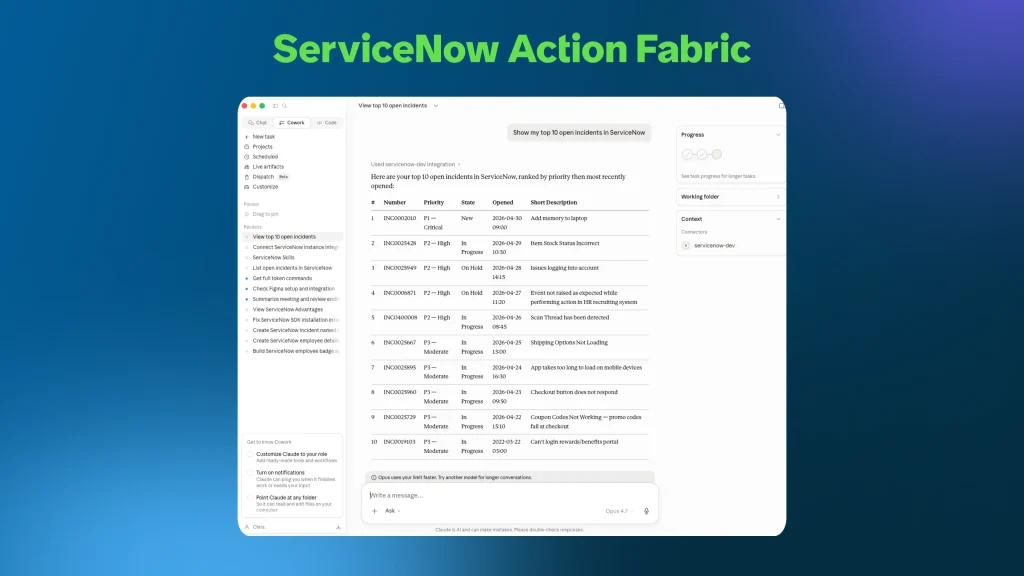
One of the first partners ServiceNow signed up is Anthropic. Claude Cowork will connect directly to Action Fabric, allowing employees to move from conversation to execution without leaving their workspace.
The example ServiceNow offers is that a new employee is struggling to access tools. Instead of logging tickets, an AI agent identifies the gaps, routes requests through approval workflows, and resolves them.
“The gap between knowing what needs to happen and making it happen is where productivity dies,” said head of Claude Code at Anthropic, Boris Cherny.
ServiceNow believes Action Fabric will help close that gap.
Final Thoughts
If Agent Fabric was about connecting AI, Action Fabric is about controlling what AI does.
There are plenty of platforms enabling AI agents to read data, call APIs, or automate tasks. ServiceNow is betting that the real enterprise battleground is governance and execution at scale.
The company is effectively saying that AI will be everywhere, and most of it will be outside your control. The value comes when it executes real work – and that work needs to run through a governed platform. That plays directly to ServiceNow’s strengths: workflows, approvals, auditability, and enterprise-grade controls.
The question now for the ecosystem is how widely this model will be adopted. Will enterprises standardise on a single “system of action” for all agent-driven work? Or will execution fragment the same way data and apps did before it?
Either way, ServiceNow is positioning itself at the centre of that decision.