





With over a hundred different ServiceNow credentials in the market and a wide range of implementation certifications across different applications and roles, the Certified Implementation Specialist in Customer Service Management (CIS-CSM) has rapidly become one of the most in-demand among practitioners.
The ServiceNow platform has matured significantly in managing customer services, extending its powerful service management capabilities, which originally started internally in IT, to external customers and partners. This has opened a clear path for ServiceNow to enter the Customer Relationship Management (CRM) market.
As ServiceNow CSM products have evolved and market dynamics have shifted, the topics, format, and structure of this certification exam have changed over time. I completed my CSM training a long time ago, but I only recently had the chance to take the exam and receive my certification, which feels quite rewarding.
Spending around 10 years in the ServiceNow ecosystem, from Business Analyst and Project Manager roles to Process Owner and Platform Product Owner, I’ve seen firsthand how CSM bridges the critical gap between front-line customer service and back-office operations.
For most ServiceNow implementers, CSM has been a logical path, especially for those interested in service management and customer service solutions, after earning their Certified System Administrator (CSA). For me, it marked a big shift from platform capabilities and IT mindset to a completely new domain focused on customers and consumers outside my organization.
In this guide, I’ll take you on a journey to learn what the ServiceNow CIS-CSM certification exam covers and how to prepare for it efficiently. I’ll explain the different domains of the exam, what features and capabilities they cover, and what comes next once you achieve this certification. I’ll also share some of my experiences along the way.
Who Is This Path For?
CSM is a great option if you’re interested in customer service and external customer support workflows, especially when it aligns with your company’s strategies and career goals. It also pairs perfectly with IT Service Management (ITSM), where many ServiceNow professionals and implementers get them together to master both internal and external service delivery.
For CSM, you need some level of knowledge and experience in the domain. ServiceNow recommends practical experience implementing CSM or maintaining the CSM application suite. However, everything relevant could help build that knowledge and experience. It could be your knowledge of customer service processes, industry data structures, or case workflows. Or, it could be working in Customer Services using the ServiceNow platform.
When I started my ServiceNow CSM journey, I completed a range of training courses, including the CSM Essentials, and kept them up to date with new releases, which helped me stay on top of the latest changes and enhancements. Over time, it was the add-on micro-certifications and industry-based delivery accreditations that kept me going, especially when mixed with AI and Now Assist skills. I was also lucky to see how they all work in a corporate instance and evolve as we’ve matured. I used that opportunity to gain experience and apply many of the features and capabilities to different customer solutions.
Now, whether you are a ServiceNow customer, partner, or employee, or just new to the ServiceNow job market and interested in becoming a Certified Implementation Specialist in Customer Service Management, this is the path for you.
Why the CSM Certification Matters
The CIS-CSM is widely recognized in the market and is a good starting point for the CRM world. It is highly sought after by ServiceNow partners and customers looking to transform their customer experience. It is a prerequisite for an expert program certification and the starting point for achieving many Suite certifications.
For me, as with many other implementation specialists, unlocking my implementation certifications with CSM was a turning point that opened up huge opportunities, enabling me to lead dozens of successful ServiceNow implementations and transformations. And once unlocked, it was much easier for me to aim and achieve other implementation certifications.
With years of experience as a ServiceNow implementation specialist and certified practitioner, I can see how the platform and CSM knowledge I gained through the ServiceNow fundamentals and implementation courses, followed by their dedicated certifications, have helped me earn industry recognition and competitive differentiation, leading to greater productivity and results.
These certifications, when bundled with relevant experience, offer a great opportunity to validate your expertise across the platform. This has become more important as ServiceNow has opened up its CRM solutions and is focusing on expanding to vertical markets.
What to Expect on the Exam
There have been some structural changes in the exam domains over the years; for example, the focus shifted away from engagement methodology and project planning to the CSM foundational data model, CSM Workspace was introduced, Case Management was highlighted, the CSM integration domain was removed, and a busy domain was split into two domains to keep CSM Best Practices and Knowledge Management separate. And this shift could soon go towards the use of AI and ServiceNow’s Now Assist Skills and capabilities.
This exam, as the name implies, is about implementing the CSM suite of products in alignment with industry standards. It focuses on key implementation domains, including scoping and requirements gathering, design and architecture, lifecycle management, data models, configuration, and best practices.
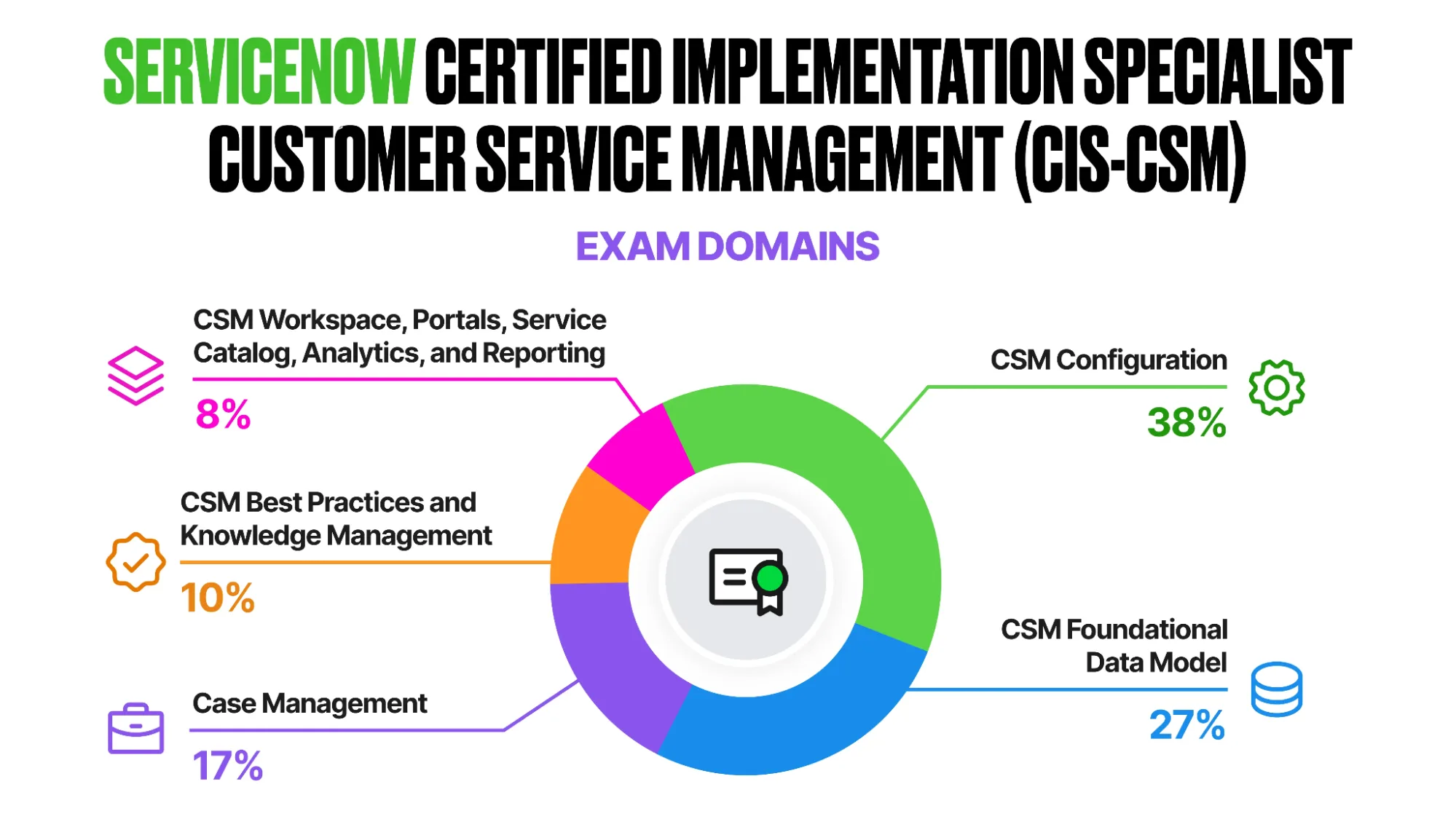
According to the ServiceNow exam blueprint, there are five domains for the main CSM products and practices that you will be tested on with 60 multiple-choice and multiple-select questions during a 90-minute period. The domains are the key topics and specific objectives included in the exam.
I have put together this chart to show you the breakdown of domains and their share of exam questions.
Registering and scheduling the exam is done via the ServiceNow University, where you are redirected to the Pearson VUE platform to book your exam and take it either online (proctored) or in an approved test center. Once you complete the exam, you will receive your results with a breakdown of domains and how you performed in each domain.
Deep Dive Into the Domains
The ServiceNow CSM exam covers the main customer service products and practices from an implementation perspective. It’s full of platform features and functionalities, applications and capabilities, along with their architecture and configuration. The domains guide what to focus on, and the breakdowns suggest the topics you’ll be tested on. In this section, I’ve explained what each domain covers and what to expect.
An important point to note is the difference in the business models. Unlike ITSM, which is mostly internal, CSM heavily relies on understanding B2B (Business to Business), B2C (Business to Consumer), and B2B2C structures, and how contacts, accounts, and consumers interact within them.
Three-quarters of the exam questions are around the CSM configuration and its foundational data model. A good portion of the exam also covers managing customer cases. There are also domains covering related topics that are equally important but contribute less to the exam, such as adhering to best practices, working with the workspace interface, pulling reports and visualizations, accessing knowledge articles, and submitting requests on the portals.
This domain is the bedrock of your CSM implementation. If you don’t get the foundational data right, the rest of the application won’t function smoothly. It focuses on distinguishing between core business models, including B2B, B2C, B2B2C, and B2B2E (B: Business, C: Consumer, E: Employee). You should know how to properly structure and relate customer accounts, contacts, consumers, and households.
You will need a deep understanding of product models and Install Base Management, essentially tracking what the customer bought versus what they actually have installed. You should also know how to configure and manage contracts and entitlements, which determine the level of support a customer is eligible for under their Service Level Agreements. Hands-on experience with configuring account consumers, sold products, and installed base items is critical here.
This is the heavyweight domain, accounting for the biggest share of the exam. It focuses mainly on Interaction Management and how cases are initiated, assigned, and routed. You need to be comfortable with Advanced Work Assignment (AWA) and how routing and assignment rules push work to the most qualified agent.
It also covers Case types, service definitions, and channels. Customers can interact with your organization through various channels: email, chat, walk-up, telephony, and portals. Understanding how these channels are configured, including creating new email interaction flows, Agent Chat, Live Agent, and Virtual Agent, and how they generate cases, is crucial here. You will also need to grasp the “Lookup and Verify” process for interactions.
Once a case is created, how is it handled? This domain covers Case state flows and the lifecycle of a case from creation to resolution and closure. It also addresses major issue management, which is how ServiceNow handles widespread issues affecting multiple customers (similar to Major Incident Management in ITSM).
You’ll also be tested on Case digests and service definitions, the CSM Workspace where agents spend their day, and how Case actions, tasks, and escalations are managed to ensure timely resolution.
To get prepared for the exam, you should have some experience working on customer cases (including case initiation as an agent) or implementing case management solutions, along with the knowledge to properly follow the processes and manage the entire lifecycle.
This domain focuses on the user experience for both the agent and the external customer. It covers the specific portals used in CSM (such as the Customer Service Portal and Consumer Service Portal), incorporating Portal Good Practices, and how the Service Catalog is integrated via Case record producers to enable customers to submit requests.
It also touches on special handling notes (pop-ups that warn agents about specific instructions or account situations), SLAs, targeted communications (sending publications to a specific list of accounts/consumers), and your overall metric strategy using Platform Analytics. You should know how to configure customer service metrics and visualizations and build persona-based dashboards to track the success of your customer service operations.
The final domain is split between implementation methodology and knowledge. It covers CSM best practices that address ServiceNow architecture, end-to-end customer service processes, Guided Setup, and project scope definition. For this part, it’s beneficial to be familiar with Now Create, ServiceNow’s methodology for managing implementations.
This domain also covers Knowledge Management and its functionality overview, which focuses on features that support customer service, such as Article Quality Index (AQI), knowledge blocks (which allow you to hide or show specific blocks of text based on user criteria), searching capability, and bulk translations to support global customer bases.
How to Prepare for the Exam
If you’ve already learned or worked on ServiceNow ITSM or HR applications, you will find a lot of similarities between those and the CSM, which makes your exam experience smooth and easy. If that’s not the case, you’re still off to a good start given that you have the essential knowledge and experience.
Similar to other ServiceNow exams, my strongest recommendation is to gain hands-on experience. If you don’t have enough CSM implementation experience, building and practicing in a test environment is the best place to start. ServiceNow University offers labs with various on-demand courses, such as Customer Service Management (CSM) Essentials Simulator. They can provide guidance and help you practice and build.
To gain the necessary knowledge for the exam, there are a few ServiceNow courses to support you, including the Customer Service Management (CSM) Essentials, Knowledge Management for Customer Service Management Fundamentals, and Customer Service Management Best Practices for Implementation. They can help extend your CSM knowledge and prepare you for the exam. I still enjoy reviewing these courses after a decade of working with ServiceNow, especially when a new release goes live. There’s always something new to learn, especially with all the innovations and AI advances.
Another effective way to practice with confidence is on a Personal Developer Instance (PDI), which you can request for free on the ServiceNow Developer site. It provides you with an out-of-the-box environment in your desired release, with admin access and the ability to install most of the applications you need, including CSM and many paid applications.
You can use your PDI to play around with CSM products and capabilities, break things, and then fix them. You can try creating new features or rebuilding an existing functionality. Maybe try building a B2B account structure, creating entitlements, and configuring Advanced Work Assignment to see how things look with the base configurations versus a customized corporate environment.
My advice would be to explore and experiment as a CSM admin. Skill up in CSM data models. Practice in CSM Workspace. Set some goals for yourself and work towards them. Try to learn a new thing every day and put it into practice. And finally, use every opportunity to design, configure, test, and implement.
For more tips, download our free eBook “How to Prepare for a ServiceNow Certification”:
What Comes Next?
Achieving your CIS-CSM is a massive milestone, but it’s just the beginning!
Once you complete this certification, there are several pathways you can pursue. They could be about advancing and learning more, earning a new certification, or exploring career opportunities.
ServiceNow offers a wide range of credentials, from micro-certifications and delivery accreditations to high-stakes (mainline) and suite certifications. As for the next certification in your journey, there is a range of options that you can pick based on your interests.
You can take your CSM certification to the next level by completing some micro-credentials. Completing the Platform Analytics, Predictive Intelligence, and Virtual Agent micro-certifications will automatically grant you the ServiceNow CSM Professional suite certification, which shows your knowledge in leveraging machine learning and analytics in service management. This was one of the early suite certifications I aimed for after receiving my CSM certification, as it brought together some key platform capabilities with the CSM products. Looking back, I can clearly see how much they helped me along the way.
Completing the Now Assist for Customer Service Management (CSM) Implementation delivery accreditation on top of the CSM Professional suite grants you the Customer Service Management (CSM) Pro Plus suite certification, which highlights your skills in the next generation of AI-powered service management.
There are so many CSM-based accreditations and suite certifications that cover the vertical markets, such as financial services, healthcare and life sciences, telecommunications, manufacturing, and retail. The solutions utilize the core ServiceNow CSM engine to address the specific industry requirements and standards. Here are some of the suite certifications that you can achieve with your CIS-CSM and a few accreditations and/or micro-certifications:
- Telecommunication and Media Service Management
- Order Management – Telecom, Media, Technology (TMT)
- Healthcare and Life Sciences (HCLS) Management
- Financial Service Operations (FSO) Insurance
- Financial Service Operations (FSO) Banking and Wealth Management
- Public Sector Digital Services (PSDS)
- Retail
You can also combine the IT Service Management (CIS-ITSM) certification and the Telecommunication and Media Service Management suite certification, and receive the Technology Provider Service Management suite certification to demonstrate your ability to align Service Management practices with industry-specific technology provider solutions. I had a chance to complete some of these accreditations and receive extra credit.
There are other implementation certifications you can try next. You can either pursue CRM-specific credentials or choose a different domain based on your interests and market demand, such as IT Service Management (CIS-ITSM) or Human Resources (CIS-HR). If you’d like to follow a CRM and industry pathway, Field Service Management (CIS-FSM) is the best option and a great complement to the CSM products. I usually call them twin certifications because of their close relationship and how they are interconnected.
There are other high-stakes (mainline) exams you can explore next, depending on the career pathway you are going to take. For example, the Certified Application Development (CAD) for the Application Developer career journey, and Certified Platform Owner Associate (CPOA), Professional (CPOP), or Expert (CPOE) for the Platform/Product Owner career journey.
Last but not least, you can apply for a ServiceNow Expert program, such as Architecture Excellence (ArchX), and, more specifically, the Certified CRM Architect (CRMA), which requires your CIS-CSM certification or its twin, the CIS-FSM certification.
You can also proceed with the Certified Technical Architect (CTA) and the Certified Master Architect (CMA) by bringing in your CIS-CSM along with other mainline certifications.
I have put together this infographic to show you the different pathways you can take after earning your CSM certification.

ServiceNow University offers the Customer Service Management (CSM) Implementer learning path, along with a career progression pathway for the Implementers.
There are also some recommended ServiceNow University courses for CSM Implementers to supplement their CSM knowledge and skills, such as:
- Introduction to CSM Configurable Workspace
- Customer Data Foundation Collection
- Customer Service Management Best Practices for Implementation
- Case Types, Service Definition, Service Catalog Fundamentals
- CRM Foundations Path
- Customer Relationship Management: Customer Product and Customer Data
- Knowledge Management for Customer Service Management Fundamentals
Similar to other ServiceNow mainline certifications, you will need to keep your CIS-CSM certification current by taking the annual delta exam as part of the ServiceNow certification maintenance program. The CSM Delta Exam Study Guide is a good resource for preparation. They are based on the latest product changes and new capabilities that help you skill up and keep your knowledge up to date.
Next, feel free to ask questions in the ServiceNow Community, take some on-demand courses you are interested in on the ServiceNow University site, and keep building on the ServiceNow Developer site.
Final Thoughts
The CIS-CSM is a widely recognized ServiceNow implementation certification for anyone looking to build a serious career in Customer Service Management. It is commonly a challenging but incredibly rewarding certification that validates your ability to configure and implement powerful customer service solutions.
Earning this certification showcases not just your technical knowledge of ServiceNow CSM products but also your deep understanding of how to align CSM best practices with real-world business processes and user experiences.
Reflecting on my own journey over the last decade, I see the CSM path, along with its certifications, as a massive turning point for me. It gave me the technical foundation and domain expertise to go beyond IT services and bridge the gap between front-line customer service and back-office operations.
A great thing about CSM is that it can be easily integrated with other ServiceNow products and processes, especially with ITSM, to provide technical support for issues or inquiries related to customers’ products and services. It can link a case to an incident, problem, change, or request. Another great example is its integration with FSM for on-site support, which allows field technicians to be sent to customers to repair, maintain, and install products and services by creating a work order.
The ServiceNow CRM ecosystem is growing faster than ever, especially as AI, Now Assist capabilities, and industry-specific verticals take center stage. Achieving your CIS-CSM is your ticket into this high-demand, fast-moving world.
To be successful in this exam, you will need to dedicate yourself, allocate time regularly to study and review the ServiceNow University course materials, and practice on the platform on a test or Personal Developer Instance (PDI) to get the necessary skills and experience.
My ultimate advice is to embrace the hands-on practice. That hands-on experiment is where real confidence and expertise are built. While the certification is a great way to showcase your product knowledge and skills, it doesn’t guarantee you can solve real business problems or handle complex, real-world scenarios unless you pair it with experience or significant practice.
Remember that validating your knowledge and expertise is a journey, and that being a ServiceNow-certified professional is a continuous process. You need to keep up to date and apply what you learn as you move up. The knowledge you gain here serves as a solid foundation as you explore other domains, pursue advanced programs and suite certifications, and leverage AI-powered capabilities.
To help you reach this goal, I have created practice tests to familiarize you with the exam format in a simulated environment with questions similar to those you should expect on the exam. I have also created some tutorial videos on YouTube for the ServiceNow exam preparation that provide additional guidance. So, feel free to browse and enjoy.
Achieving the CIS-CSM is a huge milestone that opens doors to new opportunities. Trust the process, take advantage of the available learning resources, and keep building.
Good luck with your preparation, enjoy the journey, and I look forward to seeing you succeed in the ServiceNow community!