





There is a wide range of ServiceNow credentials across different applications, practices, and industries, and the Certified Implementation Specialist in IT Service Management (CIS-ITSM) is the most demanding implementation certification in the market. This was one of the earliest and longest-standing certifications introduced after ServiceNow moved to domain-specific credentials.
This certification gained a lot of attention among IT practitioners, with ITSM being ServiceNow’s early focus, and the platform is well-matured in IT Services. As the ITSM products evolved and the market dynamics shifted, the topics, format, and structure of this certification exam have changed over time. I completed my ITSM training and received my certification a long time ago, and have seen how it has greatly helped me in my roles over the years, from ServiceNow Business Analyst and Project Manager to Platform and ITSM Process Owner and Product Owner.
For most other ServiceNow professionals and me, this was the second certification achieved, after the Certified System Administrator (CSA), and it marked a big shift from generic platform navigation, administration, and capabilities to a domain-specific focus on implementation. Now, it’s probably going to be the third with CIS-Data Foundations certification on the way as a prerequisite.
So, if you’re here, you most likely have other ServiceNow certifications and some experience with the platform. If so, you’re off to a great start. If you’re new and only evaluating your options, you’re in the right place to learn what you need before taking this path.
In this guide, I’ll take you on a journey to learn what the ServiceNow CIS-ITSM certification exam covers and how to prepare for it efficiently. I’ll explain the different domains of the exam, what features and capabilities they cover, and what comes next once you achieve this certification. I’ll also share some of my experiences along the way.
Who Is This Path For?
This is for you if you’ve received your CSA certification and have been wondering what’s next! ITSM is one of the strong options if you’re keen to pursue IT, considering it’s aligned with your interests, your company objectives, or career goals. Also, note that the Certified Implementation Specialist – Data Foundations (CMDB and CSDM) certification has recently become a prerequisite, so go for it first if you haven’t already.
Domain-specific certifications usually require some level of knowledge and experience in that domain, and ITSM is no exception. ServiceNow recommends six months of general platform experience and six months of implementation experience. However, everything relevant could help build that knowledge and experience. It could be your knowledge in IT service management and ITSM frameworks, such as ITIL, your familiarity with IT best practices and processes, or your experience with ITSM tools and platforms.
When I started my ServiceNow ITSM journey, I completed a range of training courses, including ITIL Foundation, and kept them up to date with new releases; now the new ITIL (Version 5) is my target. ServiceNow also keeps its training courses up to date with new releases, which helps stay on top of the latest changes and enhancements.
Whether you are a ServiceNow customer, partner, or employee, or just new to the ServiceNow job market and interested in becoming a Certified Implementation Specialist in IT Service Management, this is the path for you.
As the name implies, it was originally designed for consultants, implementers, and architects responsible for implementing ITSM best practices and solutions that support businesses with their processes. Later, it became the key for anyone looking to upskill in managing and configuring incidents, problems, change requests, and catalog items, and integrating them with the CMDB. It also became an effective way to learn how to improve service delivery experience and efficiency.
Why the ITSM Certification Matters
The CIS-ITSM is one of the most acknowledged certifications in the market and ranks second in the number of certification holders globally, right after the Certified System Administrator (CSA). It is a prerequisite for a few other certifications, including an Expert program and three Suite certifications. It is also the most recommended certification in the implementation specialist pathway, and a good starting point to the ITSM world.
For me, as with many other implementation specialists, ITSM was a turning point that opened up a world of opportunities, empowering me to lead dozens of successful ServiceNow ITSM implementations and transformations across large-scale organizations. And once unlocked, it was much easier for me to aim and achieve other implementation certifications.
With years of experience as a ServiceNow implementation specialist and certified practitioner, I can see how the platform and domain knowledge I gained through the ServiceNow fundamentals and implementation courses, followed by the CSA and CIS-ITSM certifications, have helped me earn industry recognition and competitive differentiation, leading to greater productivity and results. These certifications offer a significant opportunity to validate your expertise across the platform, given your relevant experience.
What to Expect On the Exam
There have been a few changes in the exam domains over the years; for example, Knowledge Management was replaced by Service Portfolio Management, and Release Management was removed. There has also been a shift in the user interface and the use of the Service Operations Workspace. And there is now some focus on the use of AI and ServiceNow’s Now Assist Skills and capabilities.
This exam, as the name implies, is about implementing the ITSM suite of products in alignment with best practices. It focuses on key implementation domains, including scoping and requirements gathering, design and architecture, lifecycle management, configuration, and integrations.
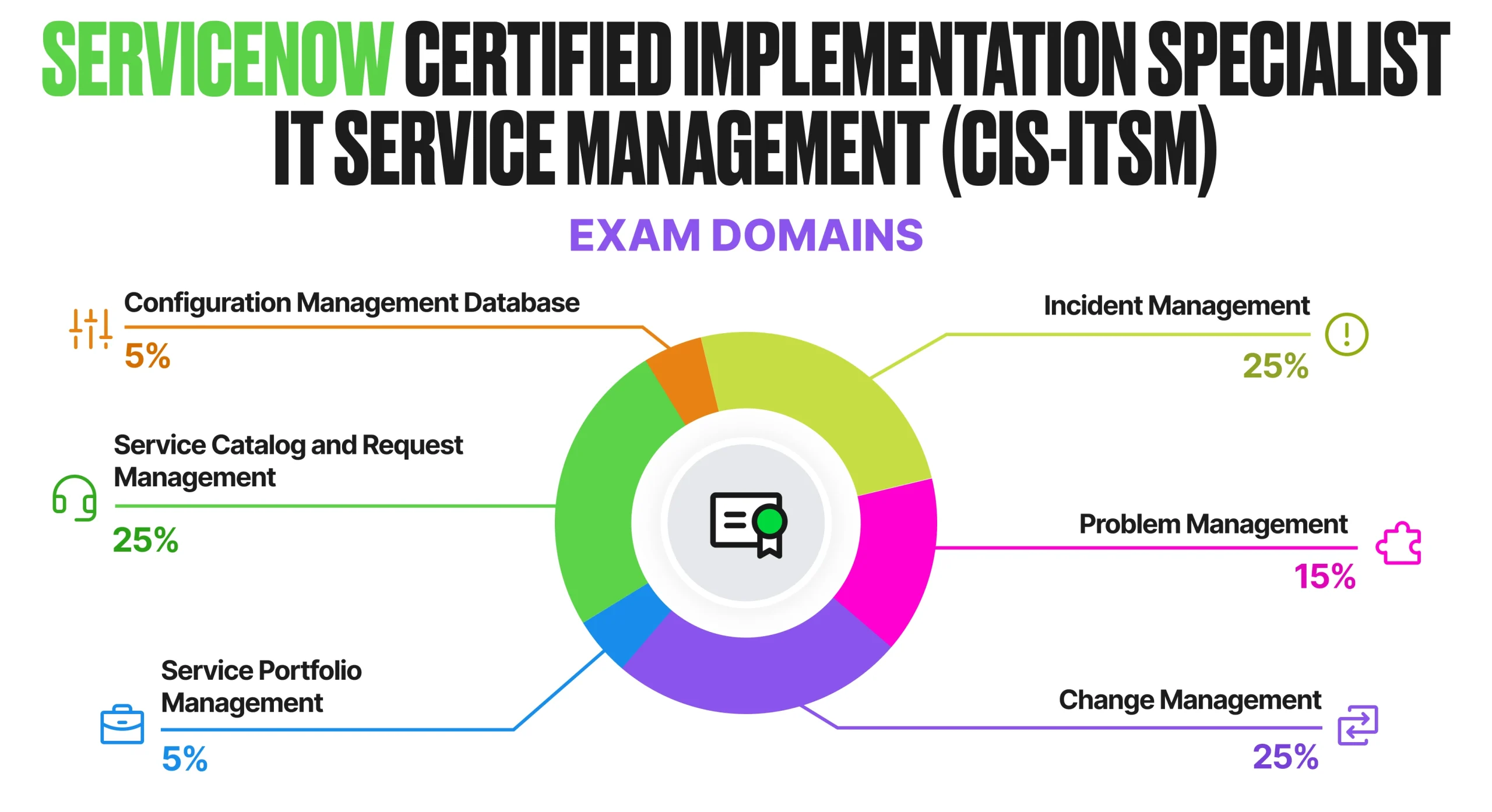
According to the ServiceNow exam blueprint, there are six domains for the main ITSM products and practices that you will be tested on with 60 multiple-choice and multiple-select questions during a 90-minute period. The domains are the key topics and specific objectives included in the exam.
I have put together this chart to show you the breakdown of domains and their share of exam questions.
Registering and scheduling the exam is done via the ServiceNow University, where you are redirected to the Pearson VUE platform to book your exam and take it either online (proctored) or in an approved test center. Once you complete the exam, you will receive your results with a breakdown of domains and how you performed in each domain.
Deep Dive Into the Domains
The ServiceNow ITSM exam covers the main IT products and practices from an implementation perspective. It’s full of platform features and functionalities, applications and capabilities, along with their architecture and configuration. The domains guide what to focus on, and the breakdowns suggest the topics you’ll be tested on. In this section, I’ve explained what each domain covers, what they include, and what to expect.
The first thing to know is that there are multiple user interfaces for different personas to access, submit, approve, fulfill, resolve, and manage. I’ve listed some of them here:
- Employee Center portal and Now Mobile app for end users and approvers to access the catalogs, submit, approve, and track requests and inquiries.
- Service Operations Workspace (SOW) and Mobile Agent app for agents, including fulfillers, resolvers, and process teams to work on tasks, such as requests and incidents.
- The classic user interface for all users based on their access level and role on the platform.
Another important point to note is that ITIL is the most common system role in the ServiceNow ITSM world, providing broad and powerful access across the entire ITSM suite. There are other overarching roles, such as the Service Desk Agent and Business Stakeholder, that provide access to a number of ITSM products. There are also granular roles for each application, such as application admin, manager, and user, along with write and read-only roles that provide targeted access based on business requirements.
This exam is focused on key ITSM products and processes. Three-quarters of the exam questions are around the main ITSM practices: Incident, Change, and Request Management. There are also the Configuration Management Database and Problem and Service Portfolio Management, which are equally important but contribute less to the exam.
The most important thing about the exam domains is their relations and interconnectivity. An inquiry could end up as a request or an incident. The incident could turn into a problem. They may all require a change to be implemented to fulfill a request or fix an issue. All of them are linked to configuration items and related to service portfolios. Everything is linked here, and they all make sense together.
This is the most common practice in IT Service Management. However, it is sometimes overused for everything IT, regardless of whether it is an idea, a request, a problem, or a true incident. Although it shouldn’t matter to the end users, the Service Desk or the Support Team needs to record it appropriately so the right processes are triggered and followed.
The Incident Management domain covers a wide range of topics, from scoping and requirements gathering to designing, architecture, and configuration. It addresses the roles and responsibilities (such as Process Owner, Incident Manager, Service Desk Agent, and IT Support Team) and core process configurations, such as the Incident lifecycle, process flow, and state transitions. It also includes:
- Pathways to create an Incident, such as the Employee Center, automated alerts, Walk-up Experience, and Virtual Agent.
- Interaction with other processes, such as Problem Management, Change Management, Outage Management, Knowledge Management, and Service Catalog.
- Service Level Management, including Response and Resolution SLAs.
- The role of Service Operations Workspace (SOW) in providing a unified experience for IT Managers, Agents, and Operators in managing Incidents.
From a lifecycle perspective, it starts with logging, classifying, and prioritizing Incidents, continues with assigning and investigating, and ends with resolving and closing them. It’s important to have a good understanding of the Priority Matrix to manage incidents more efficiently and align with SLA expectations. Another important topic is classifying Incidents by Category and Subcategory, or by Service, Service Offering, and Configuration Item, to align with the Common Service Data Model (CSDM).
To improve the user experience and align with business processes, Incident Management enables users to use task templates and pre-defined responses using Quick messages, Response templates, and Email templates. There are also tools to bring in visibility for better analysis, such as Success Dashboards and Performance Analytics tools, including KPI Composer, KPI Details, and Spotlight.
There is also Major Incident Management, covering the steps to propose an Incident as a Major Incident candidate, the trigger criteria for auto-proposal, and the process for promoting it to a Major Incident. This topic also covers Major Incident assignments, Post Incident Reports (PIR) and their timelines, Incident Communication Plans, and the use of Playbooks (e.g., to automatically create a Problem from a resolved Major Incident).
It also covers some of the automation, machine learning, and AI capabilities on the platform, such as the use of:
- Predictive Intelligence and Task Intelligence to automatically determine field values such as the Category and Assignment group.
- Issue Auto Resolution (IAR) to automatically resolve an Incident by triggering Virtual Agent Topic flows.
- Advanced Work Assignment and Assignment Rules to automatically assign Incidents based on CI attributes or Incident classification.
- Now Assist to summarize Incidents, chats, and sidebar discussions, or generate resolution notes and Knowledge articles for resolved Incidents.
This is one of the neglected practices in many organizations, as they lack established processes or teams to manage Problems. Some even see Problems as a dumping ground for everything that is too complex or costly to fix. I have seen so many problems that are sitting there for years with no progress.
It’s important to understand the processes and follow the best practices. To get prepared for the exam, you should have some experience working on Problems or implementing problem management solutions, along with the knowledge to properly follow the processes and manage the entire lifecycle.
The Problem Management domain focuses on early scoping and requirements gathering and covers the architecture and Problem lifecycle configuration. The topics are the roles and responsibilities (such as Process Owner, Problem Coordinator, and Technical Support) and the core process configurations, including process flows and state transitions across different Problem Management models. It also includes pathways to create a Problem (such as from an existing Incident, directly from the platform, or via automated alerts) and interactions with other processes, such as Incident Management, Change Management, and Outage Management.
From a lifecycle perspective, a problem starts with logging basic information, assessing and prioritizing genuine problems, and continues through investigating root causes, applying fixes, and resolving them. To improve the user experience and align with operational processes, Problem Management enables users to coordinate investigations using Problem Tasks and Known Error articles, making workarounds easier to discover.
The process covers managing risk-accepted problems and communicating workarounds and fix notes to the caller and the assignee of the related incidents. There are also tools to improve visibility for better analysis, such as dashboards to track KPIs and metrics, like the percentage of incidents resolved by fixing Known Errors and addressing aged problem backlogs.
Here are also some communication features on the platform to help with the Problem Management processes:
- Inactivity monitors to automatically trigger alerts for aging Problems and avoid SLA breaches.
- Quick messages and the Email client to insert predefined text and communicate with stakeholders.
- Automated notifications to prompt action when a Problem or Problem Task is updated, assigned, or completed.
This is one of the most critical practices in the ITSM space, ensuring every change is effectively managed under proper governance. Most organizations have a well-established change management process; however, it’s not always followed consistently or correctly. Approvals are a crucial part of the Change Management process, as they are required by the relevant stakeholders at the right time. That’s when the Change Advisory Board (CAB) comes into play to ensure that change requests are ready for implementation as scheduled.
This domain focuses on the Change Management architecture and configuration, covering Change models, process flows, state transitions, and more. Some of the target roles and responsibilities for this practice are Process Owner, Change Manager, Change Requester, and Change Implementer. Part of this process involves pathways to raise a Change request (such as from an Incident, Problem, Service Catalog, or external integrations) and interactions with other processes, such as Incident Management, Release Management, and Demand Management (as well as DevOps).
The lifecycle of a Change request starts with raising new changes, assessing and evaluating the risk, then seeking approvals, scheduling at the optimal time to avoid conflicts, implementing, and reviewing the outcome until it is ready for closure. Of course, it’s important to have a good understanding of risk evaluation methods (such as Risk Assessments, Risk Conditions, and Risk Intelligence) to enable more efficient change management and ensure accurate risk levels are set. Another important topic is the use of Change Models (such as Normal, Standard, and Emergency) to provide fit-for-purpose state flows and improved traceability.
To align with operational processes, users can manage their Change requests using the Service Operations Workspace. The process also covers facilitating Change Advisory Board (CAB) meetings using the CAB Workbench, managing the overall change schedule, and reviewing failed or backed-out changes during post-implementation reviews.
There are tools to improve visibility for better analysis, such as Change Success Score dashboards, which evaluate the likelihood of future success based on a team’s history and risk prediction. There are also some automation capabilities on the platform that help with Change Management processes, including:
- Automated conflict detection to identify if a change occurs outside an agreed maintenance window, inside a blackout window, or clashes with related Configuration Items (CIs).
- Change approval policies to automatically generate approval actions based on dynamic inputs like risk, conflicts, and change success scores.
- Machine learning and Risk Intelligence to calculate dynamic risk scores based on success probability and impact.
Service Portfolio Management (SPM) shifts an organization’s focus from individual IT assets to services directly linked to business value, helping build a service pipeline, prevent duplication, and retire low-value services. Using SPM helps align with ServiceNow’s best practice guidelines. To organize this effectively, SPM uses a taxonomy of Portfolios, Tiers, Nodes, Services (Business, Technical, and Application), and Service Offerings, which define the specific scope, pricing, and Service Commitments, such as Availability and SLAs.
This domain ensures offerings are delivered within expected timeframes and costs. When incidents occur, agents can log Outages against specific Business Service Offerings, prompting the platform to automatically recalculate availability percentages for better service management.
The platform also enhances SPM through various automated tools and integrations, such as the use of:
- Service Builder to provide a step-by-step guided wizard experience to easily set up and onboard new services.
- Service Catalog integrations to directly connect Service Offerings to Catalog Items so subscribed users can easily view and request them.
- Dependency Views to visually map exactly how services, offerings, and underlying Configuration Items (CIs) are related.
- Process integrations with the Common Service Data Model (CSDM), Major Incident Management, and Continual Improvement Management (CIM) to track ongoing service health and improvements.
This is the most widely used practice in mid-sized and larger organizations, and it grows fast as they mature in their processes. It usually starts with generic requests and later on evolves into specific catalog items as the portfolio expands.
The Service Catalog and Request Management domain covers a vast range of topics, from scoping and requirements gathering to architecture, configuration, and integrations. The core process establishes a structured catalog with clear entitlements and approval workflows, enabling teams to define fulfillment durations, track progress, and measure whether service requests are completed within agreed target timelines. It also allows organizations to define, maintain, and retire catalog items.
To streamline request fulfillment, the process relies on configurations like Order Guides, Record Producers, and Content Items. The end-user experience is prioritized through flexible ordering options, including shopping carts, cart previews, order status tracking, and wishlists, all of which can be accessed seamlessly across multiple channels, such as the Employee Center, Now Mobile app, and Virtual Agent.
The platform also provides an enhanced request experience through various tools and capabilities, such as:
- Catalog Builder to simplify the setup and creation of new catalog items.
- Creator Studio for non-developers to create request-fulfillment apps to manage employee requests, approvals, and fulfillments, without writing code.
- Now Assist Gen AI to automatically generate the catalog items.
The Configuration Management Database (CMDB) is the foundation for all ITSM records in ServiceNow. Aligned with the Common Service Data Model (CSDM), it provides a framework for populating and modeling IT infrastructure data. A core part of rolling out the CMDB involves comprehensive population of Configuration Items (CIs), service modeling and mapping, and change enablement. To ensure accurate and standardized modeling, the CSDM aligns with various well-known industry frameworks, including ITIL, TOGAF, IT4IT, SAFe, and COBIT.
If you have the ServiceNow Data Foundations (CMDB and CSDM) (CIS-DF) certification, which is the prerequisite for CIS-ITSM, or you have completed the recommended courses (such as the Configuration Management Database (CMDB) Fundamentals and the Common Service Data Model (CSDM) Fundamentals) for that certification, you are well-equipped with the topics in this domain.
However, for this domain, it’s important to know how CMDB and CSDM are leveraged on the platform to align with ITSM best practices. They help track Services, Applications, and Offerings. The CMDB also utilizes various data management and synchronization capabilities to maintain healthy records and align with other operational applications, including the Identification and Reconciliation Engine (IRE), which prevents duplicate CIs and uses reconciliation rules to prioritize updates from trusted sources, ensuring a single, accurate system of record.
To centrally manage this underlying data structure, the CI Class Manager is used to define class hierarchies, identification rules, and attributes. Meanwhile, the CMDB Data Manager automates CI lifecycle operations, such as archiving, updating, or retiring records to maintain data at scale. Ongoing data quality, including completeness and correctness, is actively monitored through the CMDB Health Dashboard.
Finally, to intuitively understand the complex interdependencies between these tracked services and infrastructure, the Unified Map provides a dynamic, visual representation of CI relationships. Knowing about these tools and capabilities, and how they support IT service management, is important for the exam.
How to Prepare for the Exam
If you are at this point, you have already taken a couple of ServiceNow mainline exams and earned your certifications, so it should be easier this time. Similar to other ServiceNow exams, my strongest recommendation is to gain hands-on experience. If you don’t have enough ITSM implementation experience, building and practicing on a test environment is the best place to start. ServiceNow University offers labs with various on-demand courses (such as the IT Service Management (ITSM) Fundamentals Simulator and IT Service Management (ITSM) Implementation Simulator). They can provide guidance and help you practice and build.
To gain the necessary knowledge for the exam, there are a few ServiceNow courses to support you, including the IT Service Management (ITSM) Fundamentals and the IT Service Management (ITSM) Implementation. They can help extend your ITSM knowledge and prepare you for the exam. I still enjoy reviewing these courses after a decade of working with ServiceNow, especially when a new version goes live for a new release. There’s always something new to learn, especially with all the innovations and AI advances.
Another effective way to practice with confidence is on a Personal Developer Instance (PDI), which you can request for free on the ServiceNow Developer site. It provides you with an out-of-the-box environment in your desired release with admin access and the ability to install most of the applications you need, including many paid ones.
You can use your PDI to play around with ITSM products and capabilities, break things, and then fix them. You can try creating new features or rebuilding an existing functionality. This is the best way to see how things look with the base configurations compared to a personalized or customized corporate environment.
My advice would be to explore and experiment as an ITSM admin. Skill up in an ITSM framework, such as ITIL. Set some goals for yourself and work towards them. Try to learn a new thing every day and put it into practice. And finally, use every opportunity to design, configure, test, and implement.
What Comes Next?
Once you complete this certification, there are several pathways you can pursue. They could be about advancing and learning more, earning a new certification, or exploring career opportunities.
ServiceNow offers a wide range of credentials, from micro-certifications and delivery accreditations to high-stakes (mainline) and suite certifications. As for the next certification in your journey, there is a range of options that you can pick based on your interests.
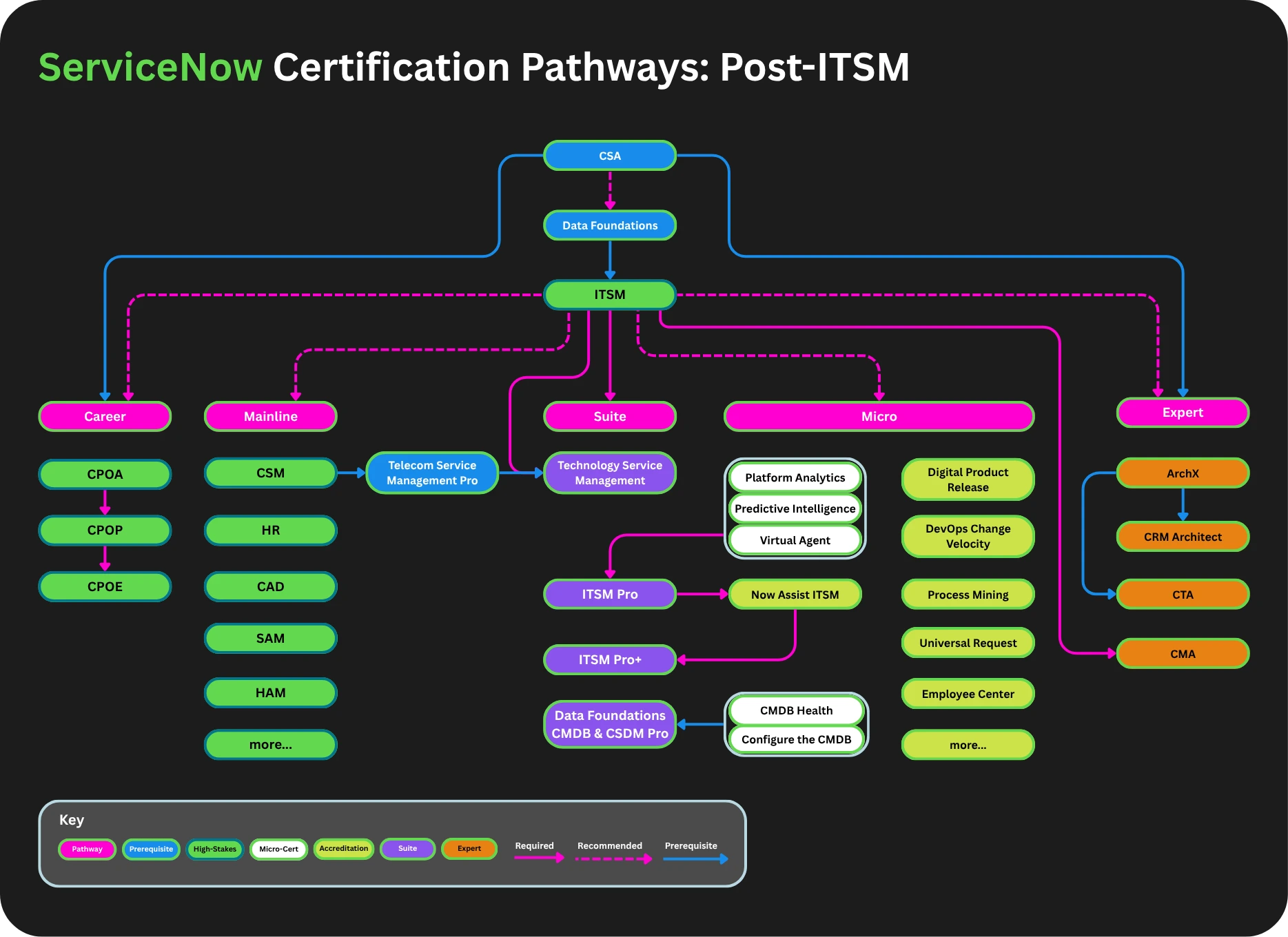
You can take your ITSM certification to the next level by completing some micro-credentials. Completing the Platform Analytics, Predictive Intelligence, and Virtual Agent micro-certifications will grant you the ServiceNow ITSM Professional suite certification, which shows your knowledge in leveraging machine learning and analytics in service management. This was the first suite certification I aimed for when it was introduced, as it brought together some key platform capabilities with the ITSM products. I can clearly see how much they helped me along the way.
Completing the Now Assist for IT Service Management (ITSM) Implementation Delivery Accreditation on top of the ITSM Professional suite grants you the IT Service Management (ITSM) Pro Plus suite certification, which highlights your skills in the next generation of AI-powered service management.
You can also combine the Telecommunication and Media Service Management Professional suite certification, which is in the Customer Service Management (CSM) domain, and go for the Technology Provider Service Management Professional suite certification to demonstrate your ability to align Service Management practices with industry-specific technology provider solutions.
There are other implementation certifications you can try next. You can either pursue IT-specific credentials or choose a different domain based on your interests and market demand, such as Customer Service Management (CIS-CSM) or Human Resources (CIS-HR). There are a few options if you’d like to follow an IT or technology pathway, such as:
- IT Operations Management (ITOM), including:
- IT Asset Management (ITAM), including:
- Security Operations (SecOps), including:
There are other high-stakes (mainline) exams you can explore next, depending on the career pathway you are going to take. For example, the Certified Application Development (CAD) for the Application Developer career journey, and Certified Platform Owner Associate (CPOA), Professional (CPOP), or Expert (CPOE) for the Platform/Product Owner career journey.
Last but not least, you can apply for a ServiceNow Expert program, such as the Certified Technical Architect (CTA) or the Certified Master Architect (CMA), by bringing in your CIS-ITSM along with other mainline certifications.
I have put together this infographic to show you the different pathways you can take after earning your ITSM certification.
ServiceNow University offers the IT Service Management (ITSM) Implementer learning path, along with a career progression pathway for the Implementers.
There are also some recommended ServiceNow University courses for ITSM Implementers to supplement their ITSM knowledge and skills, such as:
- Service Operations Workspace (SOW) Essentials and Bootcamp.
- Digital Product Release (DPR) Essentials and Bootcamp (comes with a Delivery Accreditation).
- Major Incident Management (MIM) Fundamentals and Implementation.
- DevOps Change Velocity Fundamentals and Implementation (comes with a micro-certification).
- Knowledge Management (KM) Fundamentals and Implementation.
Similar to other ServiceNow mainline certifications, you will need to keep your CIS-ITSM certification current by taking the annual delta exam as part of the ServiceNow certification maintenance program. The ITSM Delta Exam Study Guide is a good resource for preparation. They are based on the latest product changes and new capabilities that help you skill up and keep your knowledge up to date.
Next, feel free to ask questions in the ServiceNow Community, take some on-demand courses you are interested in on the ServiceNow University site, and keep building on the ServiceNow Developer site.
Final Thoughts
The CIS-ITSM is the most widely recognized ServiceNow implementation certification on the market, with the largest number of certification holders. It is definitely an important credential for anyone looking to build a serious career as a ServiceNow implementation specialist, consultant, or architect, especially in the ITSM space.
Earning this certification showcases not just your technical knowledge of the platform, but your deep understanding of how to align IT Service Management best practices with real-world business processes and user experiences.
To be successful in this exam, you will need to dedicate yourself, allocate time regularly to study and review the ITSM Fundamentals and Implementation course materials, and practice on the platform on a test or Personal Developer Instance (PDI) to get the necessary skills and experience.
I can’t stress enough how much of a difference hands-on experience and continuous practice on a ServiceNow instance will make. After all, while the certification is a great way to showcase your product knowledge and skills, it doesn’t guarantee you can solve real business problems or handle complex, real-world scenarios unless you pair it with experience or significant practice.
Remember that validating your knowledge and expertise is a journey, and being a ServiceNow certified professional is a continuous process. You need to keep up to date and apply what you learn as you move up. The knowledge you gain here serves as a solid foundation as you explore other domains, pursue advanced suite certifications, and leverage AI-powered capabilities such as Now Assist.
To help you reach this goal, I have created practice tests to familiarize you with the exam format in a simulated environment with questions similar to those you should expect on the exam. I have also created some tutorial videos on YouTube for the ServiceNow exam preparation that provide additional guidance. So, feel free to browse and enjoy. Achieving the CIS-ITSM is a massive milestone that opens doors to new opportunities. Trust the process, take advantage of the learning resources available, and keep building.
Good luck with your exam, and I look forward to seeing where your ServiceNow journey takes you next!
Comments: