






ServiceNow certifications are getting a lot of attention these days, especially among IT organizations, with the Certified System Administrator (CSA) serving as the entry point into this demanding market and a gateway to new opportunities.
Having spent around a decade in the ServiceNow ecosystem, exploring various roles and wearing multiple hats, I came to realize that my early decision to deepen my platform knowledge and earn certification had a positive impact on my career.
For me, as with many other professionals, CSA was the catalyst for new experiences and advanced credentials. It provided the foundation for building my skills and broadening my expertise, ultimately empowering me to lead dozens of successful ServiceNow implementations and transformations across multiple applications and modules.
In this guide, I’ll take you through a journey to explore what the ServiceNow CSA certification exam is about and how to prepare for it efficiently. I’ll explain the different domains of the exam, what platform features and products they cover, and what comes next once you achieve this certification. I’ll also share some of my experiences along the way.
Who Is This Path For?
Whether you are a ServiceNow customer, partner, or employee, part of the ServiceNow RiseUp program, or just new to the job market and interested in becoming a Certified System Administrator, this is the path for you.
At first glance, the certification may seem too technical for some, especially if they are new to the IT industry or have little experience on the platform. However, it gets easier as you start navigating the platform and practicing what you learn. As the name implies, it was originally designed for admins, developers, and those responsible for supporting and maintaining the platform. Later, it became the key for anyone looking to learn the fundamentals and gain some technical expertise.
You may currently hold a title such as Support Specialist, Application Analyst, System Engineer, Technical Consultant, or IT Administrator. Whatever your title, you have a lot in common, and that is the responsibility to configure, maintain, or support, and in some cases, implement solutions. It could be the ServiceNow platform or any other system or application. Some typical examples include coordinating platform configurations, monitoring system health and performance, supporting day-to-day work, and overseeing instance security.
Why the CSA Certification Matters
The CSA is the most recognized ServiceNow certification in the market, with the highest number of certification holders. It is a prerequisite for a few other certifications and the expert programs. It is the starting point for achieving some ServiceNow Suite certifications. It is also the recommended certification for most implementation specialist pathways.
In my years of experience as a ServiceNow practitioner and certified professional, I’ve realized how the platform knowledge I gained through the ServiceNow fundamentals course, followed by the CSA certification, has helped me gain industry recognition and competitive differentiation, leading to greater productivity and results.
Something I am sure of is that CSA offers a massive opportunity to validate your expertise across the platform, given the fact that you have the relevant experience.
What to Expect on the Exam
According to the ServiceNow exam blueprint, there are six domains and 30 subdomains that you will be tested on with 60 multiple-choice and multiple-select questions during a 90-minute period. The domains are the key topics and specific objectives included in the exam.
I have put together this chart to show you the breakdown of domains and their share of exam questions.
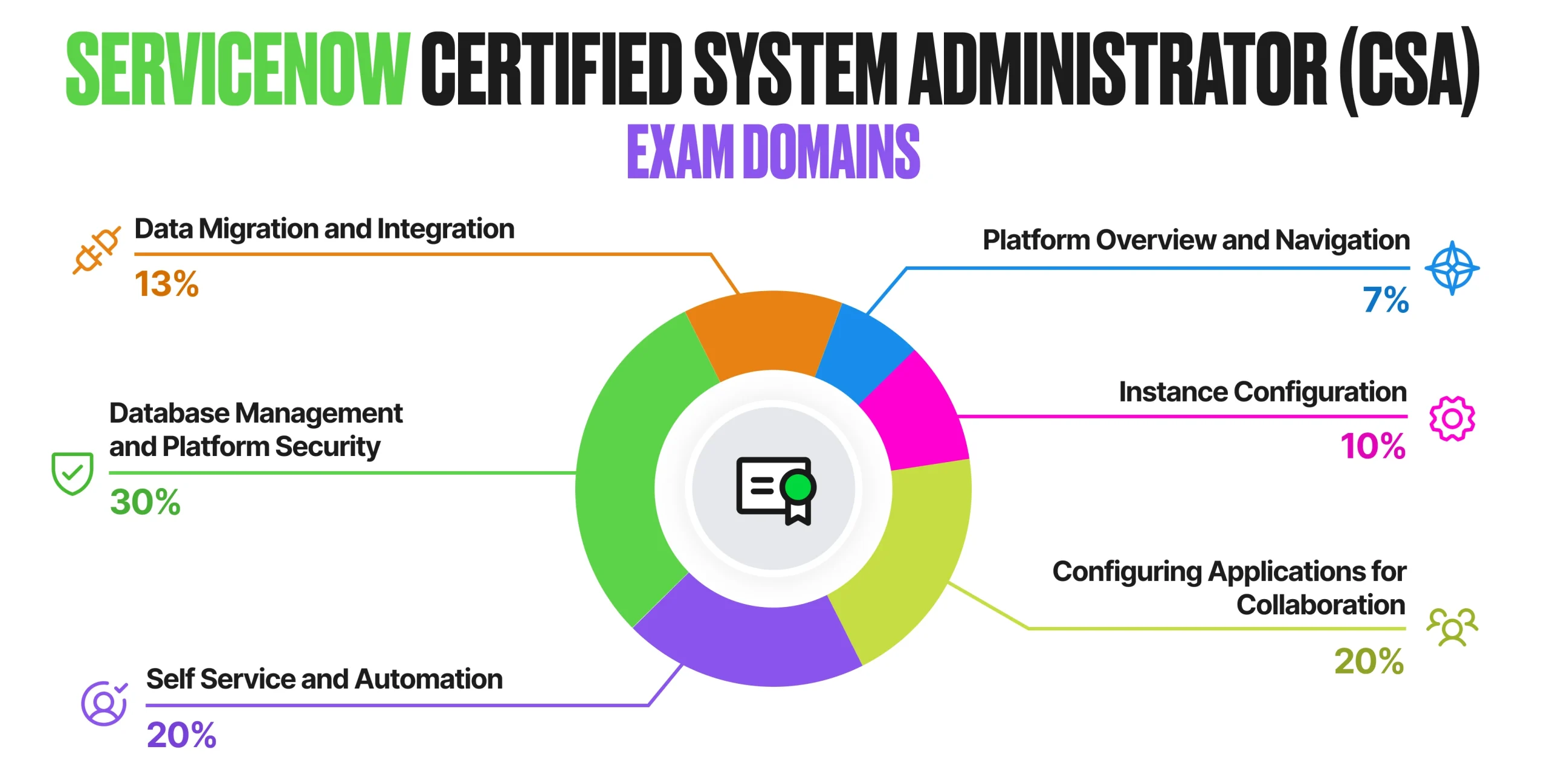
Registering and scheduling the exam is done via the ServiceNow University, where you are redirected to the Pearson VUE platform to book your exam and take it either online (proctored) or in an approved test center. Once you complete the exam, you will receive your results with a breakdown of domains and how you performed in each domain.
Deep Dive Into the Domains
The ServiceNow CSA exam has the widest coverage compared to other certification exams. It’s full of platform features and functionalities, services and applications, along with their management and administration. The domains guide what to focus on, and the breakdowns suggest the topics you’ll be tested on. In this section, I’ve explained what each domain is about, what they include, and what to expect.
There are easier, more general domains, such as “Platform Overview and Navigation,” as well as more functional domains, such as “Configuring Applications for Collaboration” and “Self Service and Automation.” Based on my observations, “Data Migration and Integration” and “Database Management and Platform Security” are the more technical domains and are usually the areas where new practitioners and learners have the most room for improvement.
This domain covers fundamentals, including an overview of the ServiceNow platform, its capabilities, and services. It also focuses on the ServiceNow instance and its user interfaces, such as the Next Experience and Workspaces, where you will be working every day. While there are relatively few questions here compared to other domains, you still need to know how to navigate the platform comfortably and find your way as an administrator.
This domain focuses on making the instance your own. It involves installing applications and plugins, as well as personalizing and customizing the instance based on your business requirements. You need to know how to configure the company branding, like changing the banner image, the browser tab title, and the system colors, to match your organization’s identity. It also covers the common user interfaces you will encounter across the platform, helping you tailor the experience for your users.
This is an important area that touches on how we work together, starting with lists, filters, and tags. You need to understand the anatomy of a list and a form, and how to configure them. Also, how to use filters to find specific data and shareable tags to associate with records and pages in order to group and organize them. When it comes to form configuration, you should be comfortable with form templates and the saving options that simplify the submission process of new records.
Task Management is another key piece, along with Visual Task Boards (VTBs), which enable you to collaborate on tasks more interactively. This domain also covers Platform Analytics. You need to know how to create and run data visualizations and dashboards to present your data and create a story to share with others. Finally, knowing about notifications is crucial. You should understand how they work, what subscribeable notifications are, and how to customize delivery channels, such as email, SMS, and push notifications.
This domain focuses on delivering a modern experience. It covers knowledge management, including the workflow for creating, approving, publishing, and retiring knowledge articles. There is the Service Catalog, which serves as a robust ordering system. You need to understand the hierarchy of catalog tasks, request items, and requests, and how they operate. This also includes their high-level designs and capabilities, the different variable types, and familiarity with other catalog item types, such as record producers and order guides.
There is an automation piece that requires some knowledge of Workflow Studio, which enables you to automate business processes across the enterprise with flows, subflows, actions, and playbooks. There is also the Virtual Agent, which you should know about, providing a friendly messaging interface with pre-built AI-powered conversations to improve your enterprise productivity. You should know how it helps users obtain information, make decisions, and perform common tasks.
I have to be honest with you: this is the heavyweight. It is the largest domain, accounting for more than a quarter of the exam questions, and, in my experience, it is definitely an area that requires more practice. It covers the data schema, which is how data are connected and related to each other. You need to understand application and access control, specifically Access Control List (ACL) rules that restrict access to data by requiring users to pass a set of requirements before interacting with it.
This domain also covers importing data, where you use import sets to map external data into ServiceNow tables. You should also learn about CMDB (Configuration Management Database) and CSDM (Common Service Data Model), especially how they are leveraged on the platform to align with best practices. Finally, you need to understand what Security Center and the Shared Responsibility Model are and how they’re used to oversee instance security effectively.
This is probably the most technical for many ServiceNow learners. This domain covers how to move and manage data and logic. This includes UI policies, which allow you to change the appearance of forms, like making fields mandatory, visible, or read-only, without code. You need to understand the difference between these and business rules, which run on the server side.
It also covers system update sets, which are used to move changes and customizations from one instance to another, such as from development to test and later to production. Lastly, scripting in ServiceNow, which is a vast topic, but for this exam, you need to understand the basics of client-side versus server-side scripting to maintain and enhance an instance effectively.
How to Prepare for the Exam
My strongest recommendation to prepare for the CSA exam is to gain hands-on experience. ServiceNow suggests three to six months of experience administering an instance. However, if you’re new to the ServiceNow world, you can start building and practicing on a test environment. A great place to start is ServiceNow University labs, available in various on-demand courses. They can provide guidance and help you practice and build.
Here are a couple of exam resources to start with: “Welcome to ServiceNow” and “ServiceNow Administration Fundamentals.” They can help extend your platform knowledge and practice in a ServiceNow environment.
I still enjoy reviewing some of these fundamentals courses after a decade working with ServiceNow. There’s always something new to learn, especially with all the innovations and AI advances.
Another efficient way to practice with confidence is through a Personal Developer Instance (PDI), which you can request for free on the ServiceNow Developer site. That provides you with an out-of-the-box environment with admin access and the ability to install most of the applications you need, including many paid ones.
You can use your PDI to play around, break things, and then fix them. You can try to create new features or rebuild an existing capability. This is the best way to see how things look with the base configurations compared to a customized corporate environment.
The good thing is that if you accidentally break something and cannot figure out how to fix it, or if you want to go back to how things were before, you can reset and wipe the instance, reverting it to the original out-of-the-box configuration.
My advice would be to explore and experiment. Set some goals for yourself and work towards them. Try to learn a new thing every day and put it into practice. And, get hands-on!
For more tips, download our free eBook “How to Prepare for a ServiceNow Certification”:
What Comes Next?
ServiceNow offers a wide range of credentials, from micro-certifications and delivery accreditations to high-stakes (mainline) and suite certifications. And, this is just the beginning!
You can start with specific micro-certifications, get your CSA, and bundle them into a suite certification. Or, get your CSA and take the certified platform owner path. Or you could take the architecture path through the expert programs, starting with Architecture Excellence (ArchX).
ServiceNow University offers an advanced administration course, along with the System Administrator learning path, credential path, and career journey. There are also career progression pathways, including Application Developer, Support Specialist, and Implementer.
Something to note is that, like other ServiceNow high-stakes certifications, you will need to keep your CSA certification current by taking the annual delta exam as part of the ServiceNow certification maintenance program. They are based on the latest platform changes and new capabilities that help you skill up and keep your knowledge up to date.
Next, feel free to ask questions in the ServiceNow Community, take some of the on-demand courses you are interested in on the ServiceNow University site, and keep building on the ServiceNow Developer site.
Sky’s the limit!
Final Thoughts
The CSA is commonly the entry point to the ServiceNow certification journey, and a must-have for most ServiceNow admin and developer jobs, and a prerequisite for advanced courses and certifications.
To be successful in the exam, you will need to dedicate yourself, allocate time regularly to study and review your fundamentals course materials, and practice on the platform on a test or personal developer instance to get the necessary skills and experience.
Remember that validating your knowledge and expertise is a journey, and being a ServiceNow certified professional is a continuous process. You need to keep up to date and apply what you learn as you move up.
Also, it is important to note that while the CSA certification is a great way to showcase your platform knowledge and skills, it doesn’t guarantee you can solve actual business problems or deal with complex, real-world scenarios, unless you have a significant amount of practice and hands-on experience.
Finally, I created some practice tests to help you familiarize yourself with the exam format and practice in a simulated exam environment with questions similar to those you should expect on the exam. I have also created some tutorial videos on YouTube for the CSA exam preparation that provide further guidance. So, feel free to browse and enjoy.
Congratulations in advance! And, I look forward to seeing you succeed in your ServiceNow journey.