






As organizations continue to face increasing regulatory requirements, cybersecurity threats, and operational risks, Governance, Risk, and Compliance (GRC) has become one of the fastest-growing domains within enterprise IT. Organizations need a centralized platform to identify risks, manage policies, monitor compliance, and conduct audits efficiently.
Mature organizations have a separate budget now for cybersecurity because of the strict regulations by governments, such as GDPR, that require them to protect customer data and follow defined security and privacy standards. And the rapid growth of AI has made cybersecurity and compliance even more important. As organizations increasingly use AI to automate business processes and make decisions, they must also ensure that these systems are secure, reliable, and compliant with industry regulations.
ServiceNow addresses these challenges through its Integrated Risk Management (IRM) suite, formerly known as Governance, Risk, and Compliance (GRC). The Certified Implementation Specialist – Risk and Compliance (CIS-RC) certification validates your ability to configure, implement, and maintain ServiceNow Risk and Compliance solutions based on business requirements.
It is intended for professionals implementing ServiceNow IRM applications and demonstrates expertise in areas such as policy management, compliance, risk assessments, entity management, and audit management.
In this guide, I’ll show you what the ServiceNow CIS – Risk and Compliance exam covers and how to prepare for it efficiently. I’ll explain the different domains of the exam, what features and capabilities they cover, and what comes next once you achieve this certification. I’ll also share some of my own experiences along the way.
Who Is This Path For?
I believe the CIS – Risk and Compliance certification is suitable for professionals from different backgrounds. Broadly, I would divide the audience into two categories.
1. Existing ServiceNow Professionals
If you’ve been working in the ServiceNow ecosystem for a couple of years and have experience in modules such as ITSM, HRSD, CSM, or ITOM, but are looking to expand your skill set into a high-demand specialization, I highly recommend learning Integrated Risk Management (IRM).
With organizations placing greater emphasis on cybersecurity, governance, risk management, regulatory compliance, and operational resilience, the demand for IRM consultants continues to grow. By learning the IRM module and earning the CIS-Risk and Compliance certification, you can broaden your expertise and position yourself for more specialized implementation and consulting opportunities.
2. Professionals Coming from Other GRC Platforms
If you are currently working on Governance, Risk, and Compliance (GRC) platforms such as Archer, SAP GRC, or similar technologies and want to transition into the ServiceNow ecosystem, this certification path is an excellent choice.
I recommend starting with the Certified ServiceNow Administrator course on ServiceNow University to build a solid understanding of the ServiceNow platform. Once you’re comfortable with the platform basics, you can move on to the CIS – Risk and Compliance training.
You’ll notice that ServiceNow follows many of the same governance, risk, compliance, policy management, and audit management principles used across other leading GRC solutions. This makes the transition much smoother while allowing you to leverage your existing domain knowledge.
When I started my IRM journey, my mentor guided me to start by learning Cybersecurity fundamentals from the ISC2 website. Personally, I found it very helpful, as I learnt a lot of new terminology and important concepts in the Cybersecurity world. I remember completing the training within a couple of days as my interest kept developing while I was going through the course. After that, I started the official ServiceNow Risk and Compliance training, worked on a few projects, and finally took my exam after a year.
Why the Risk and Compliance Certification Matters
Over the past few years, organizations have significantly increased their investment in cybersecurity, governance, risk management, regulatory compliance, and operational resilience. With regulations becoming stricter and cyber threats evolving rapidly, businesses need solutions that can proactively identify risks, ensure compliance, and strengthen their overall security posture.
ServiceNow’s Integrated Risk Management (IRM) application addresses these business challenges by providing a unified platform to manage policies, controls, risks, audits, and compliance activities. As a result, the demand for ServiceNow IRM professionals has grown considerably across industries such as banking, insurance, healthcare, manufacturing, telecommunications, and government.
From my personal experience, I spent many years working primarily on ITSM and custom application development. Like many ServiceNow professionals, I initially believed that ITSM would remain my primary area of expertise. However, as I started exploring other ServiceNow products, I realized that IRM is one of the fastest-growing and most strategic areas on the platform.
When I began learning IRM, I noticed that the concepts extend far beyond technical implementation. You start understanding how organizations identify risks, implement controls, comply with regulations, conduct audits, and make business decisions based on risk assessments. This broader business perspective makes you a better consultant and solution architect rather than just a ServiceNow developer.
Another reason I strongly recommend this certification is the relatively smaller talent pool compared to traditional modules like ITSM. While there are thousands of ServiceNow developers specializing in ITSM, organizations often struggle to find consultants with strong IRM implementation skills. This creates excellent opportunities for professionals looking to differentiate themselves in the market.
If you’re planning your long-term career in the ServiceNow ecosystem, adding IRM expertise to your profile can significantly broaden the types of projects you work on and open doors to more specialized implementation, consulting, and architecture roles.
In short, pursuing the CIS-RC certification not only validates your technical knowledge of the ServiceNow IRM applications but also equips you with valuable business and governance concepts that are increasingly important in today’s enterprise landscape.
What to Expect in the Exam
Unlike some technical certifications that focus heavily on scripting or platform administration, the CIS-RC exam is designed to test your understanding of how ServiceNow IRM applications are implemented to solve real business problems. The questions are primarily scenario-based, requiring you to identify the most appropriate configuration or implementation approach.
Here are a few things you can expect during the exam:
Focus on Business Processes
The exam emphasizes understanding why a feature is used rather than simply memorizing where it is configured. You should be comfortable with concepts such as risk assessments, compliance testing, policy management, audit management, and entity management.
Implementation Scenarios
Many questions present a business requirement and ask which ServiceNow feature or configuration best addresses that need. Understanding the end-to-end lifecycle of IRM processes will help you answer these questions confidently like Policy lifecycle, Control lifecycle and others.
Know the Relationships Between Components
Rather than studying each module in isolation, understand how different components work together. For example:
- How Authority Documents, Citations, Controls, Policies, and Compliance Tests are related.
- How Risks, Risk Assessments, Risk Indicators, and Risk Responses fit into the Risk Management lifecycle.
- How Audit Engagements, Observations, Findings, and Remediation Tasks are connected.
Having a clear picture of these relationships makes many exam questions much easier to answer.
Expect Configuration-Based Questions
The exam focuses more on configuration and implementation than on development. You should know how to configure common IRM features, when to use them, and what business value they provide.
Hands-on Experience Makes a Difference
If you’ve spent time configuring policies, creating controls, performing risk assessments, or building audit engagements, you’ll find many of the questions easier to understand because you’ll be able to relate them to real implementation scenarios.
My Advice
During my preparation for ServiceNow implementation certifications, I found that the questions rarely test isolated facts. Instead, they assess whether you understand how different IRM capabilities work together to solve real business challenges. If you combine the official training with hands-on practice and understand the complete lifecycle of Risk, Compliance, Policy, and Audit Management, you’ll be well prepared for the exam.
According to the ServiceNow exam blueprint, there are seven domains for the main Risk and Compliance products and practices that you will be tested on with 60 multiple-choice and multiple-select questions during a 90-minute period. The domains are the key topics and specific objectives included in the exam. I have put together this chart to show you the breakdown of domains and their share of exam questions.
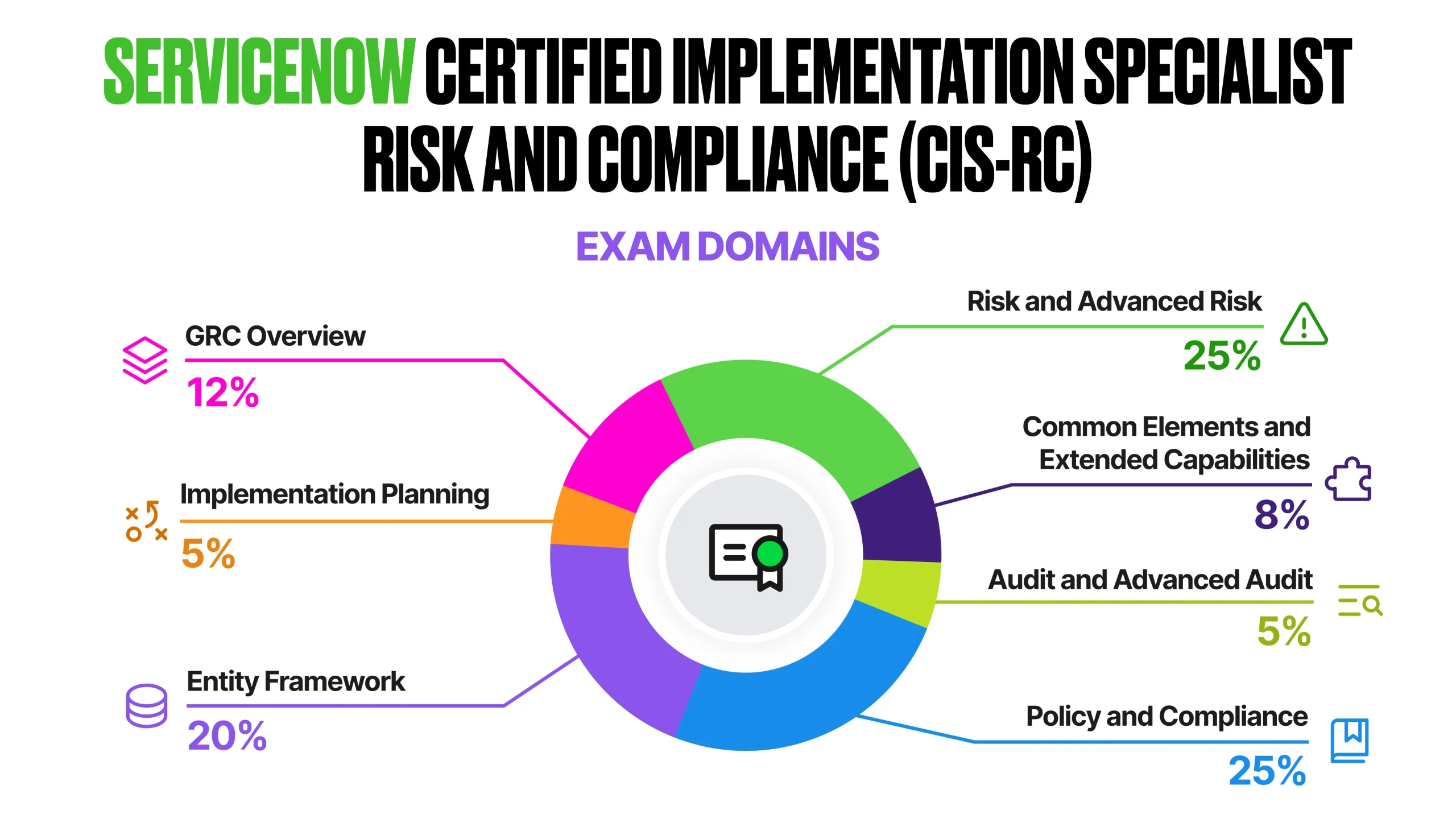
Registering and scheduling the exam is done via the ServiceNow University, where you are redirected to the Pearson VUE platform to book your exam and take it either online (proctored) or in an approved test center. Once you complete the exam, you will receive your results with a breakdown of domains and how you performed in each domain.
Deep Dive Into the Exam Domains
The CIS – Risk and Compliance certification is divided into seven domains, each focusing on a different area of the ServiceNow Integrated Risk Management (IRM) application. Some domains carry more weight than others, so understanding the exam blueprint will help you prioritize your preparation.
Let’s look at each domain in detail.
This is the foundation of the entire certification. Before you start configuring policies or risks, ServiceNow expects you to understand why organizations implement GRC/IRM and the business problems it solves.
You should be comfortable with:
- The evolution from GRC to Integrated Risk Management (IRM).
- GRC positioning within an organization.
- Core IRM terminology.
- Business benefits of implementing IRM.
- High-level architecture of the application.
Topics to Focus On
- GRC Positioning and Framework.
- Key Terminologies.
- Technical Architecture.
My Recommendation
Don’t skip this domain because it looks theoretical. Many scenario-based questions start by testing whether you understand the overall purpose of IRM before moving into configuration.
Although this domain has a relatively smaller weightage, it focuses on one of the most important aspects of any implementation planning.
ServiceNow expects you to understand how an IRM implementation should begin before any configuration is performed.
Topics to Focus On
- Identifying business use cases.
- Implementation planning checklist.
- Stakeholders involved in an implementation.
- Roles and responsibilities.
- Risk and Compliance personas.
My Recommendation
Think like a consultant rather than a developer. Understand who uses the application and why they use it.
The Entity Framework is one of the most important topics in the certification and carries 20% of the exam.
Entities represent the business objects on which risks, controls, policies, and compliance activities are performed.
For example, an organization may create entities such as:
- Business Units.
- Applications.
- Data Centers.
- Servers.
- Third-party vendors.
Once entities are defined, risks and compliance activities can be associated with them.
Topics to Focus On
- Entity Scoping.
- Entity Types.
- Entity Classes.
- Entity Architecture.
- Relationships between entities.
My Recommendation
Spend plenty of hands-on time configuring entities in your Personal Developer Instance. This concept is used throughout the IRM application.
This is one of the largest domains in the certification, contributing 25% of the exam.
The Policy and Compliance application helps organizations ensure they comply with internal policies and external regulations.
You should understand the complete lifecycle, from creating policies to testing compliance.
Topics to Focus On
- Policy lifecycle.
- Compliance record lifecycle.
- Authority Documents.
- Citations.
- Controls.
- Compliance Tests.
- Compliance architecture.
- Policy configuration.
My Recommendation
Instead of memorizing individual records, understand how these components are connected.
A simple flow to remember is:
Authority Document → Citation → Control → Policy → Compliance Test → Issue → Remediation.
If you understand this lifecycle, you’ll find many questions much easier.
This is another major domain that contributes 25% of the exam.
The objective here is to understand how organizations identify, assess, prioritize, and mitigate risks.
You’ll learn how ServiceNow enables businesses to make informed decisions by providing structured risk management processes.
Topics to Focus On
- Risk lifecycle.
- Risk Identification.
- Risk Assessments.
- Risk Scoring.
- Risk Response.
- Risk Indicators.
- Advanced Risk Assessment.
- Risk architecture.
My Recommendation
Understand the complete risk lifecycle rather than studying individual forms. Be comfortable creating advanced risk assessments and interpreting risk scores.
This domain covers the supporting capabilities that enhance the overall IRM implementation.
Although it has a smaller percentage, the questions are often practical and relate to platform features.
Topics to Focus On
- Integrations.
- Content Packs.
- Common Platform Capabilities.
- Regulatory Change Management.
- Continuous Monitoring.
My Recommendation
Pay attention to how IRM integrates with other ServiceNow applications and external systems. Also, understand the purpose of content packs and continuous monitoring.
The final domain focuses on the Audit Management application.
Organizations use Audit Management to plan, execute, and track internal or external audits efficiently.
Topics to Focus On
- Audit lifecycle.
- Audit Engagements.
- Audit Observations.
- Audit Findings.
- Audit Reports.
- Audit Personas.
- Audit Roles and Responsibilities.
My Recommendation
Understand the end-to-end audit lifecycle and how findings eventually lead to remediation activities.
Preparation Strategy Based on Domain Weightage
If I were preparing for the exam today, this is how I would prioritize my study plan:
Highest Priority
- Policy and Compliance (25%)
- Risk and Advanced Risk (25%)
- Entity Framework (20%)
These three domains together account for 70% of the certification exam, so spend most of your preparation time here.
Medium Priority
- GRC Overview (11.67%)
- Common Elements and Extended Capabilities (8.33%)
These domains provide the foundational knowledge and supporting concepts that appear throughout the exam.
Lowest Priority
- Implementation Planning (5%)
- Audit and Advanced Audit (5%)
Although these sections contribute fewer questions, they are generally easier to prepare and can help you secure additional marks.
How to Prepare for the Exam
Preparing for the Certified Implementation Specialist – Risk and Compliance (CIS-RC) exam requires more than simply reading the documentation or memorizing definitions. Since this is an implementation specialist certification, ServiceNow expects you to understand how the IRM applications work together to solve real business problems.
Based on my experience preparing for this certification, here is the strategy I recommend.
1. Complete the Official ServiceNow Training
The first and most important step is to complete the official ServiceNow IRM Implementation learning path available on ServiceNow University. The official course explains:
- IRM architecture.
- Entity Framework.
- Policy and Compliance.
- Risk Management.
- Audit Management.
- Common platform capabilities.
Most of the exam questions are based on concepts covered in the official training, so I highly recommend completing it before attempting the certification.
2. Practice Everything in a Personal Developer Instance (PDI) or ServiceNow University Instance
I can’t stress it enough. Reading alone isn’t enough. The best way to learn IRM is by implementing the concepts yourself.
I recommend creating complete business scenarios, such as:
- Creating an Authority Document.
- Creating Citations.
- Configuring Controls.
- Creating Policies.
- Performing Compliance Tests.
- Creating Risks.
- Creating Advanced Risk Assessments.
- Performing Risk Assessments.
- Creating Audit Engagements.
- Reviewing Findings and Observations.
When you configure these yourself, the relationships between different records become much easier to understand, and you remember them.
3. Focus on the High-Weightage Domains
Not every topic carries the same weight in the exam. Spend most of your preparation time on the three largest domains:
- Policy and Compliance (25%)
- Risk and Advanced Risk (25%)
- Entity Framework (20%)
Together, these account for 70% of the exam, so mastering them will significantly improve your chances of success, but it doesn’t mean that you should leave the rest of the domains.
4. Understand the Complete Business Lifecycle
One mistake many candidates make is studying each topic separately. Instead, understand how everything connects with each other.
For example, in Policy and Compliance, learn the complete flow:
Authority Document → Citation → Control → Policy → Compliance Test → Issue → Remediation
Similarly, in Risk Management, understand:
Risk Identification → Risk Assessment → Risk Scoring → Risk Response → Continuous Monitoring
The exam often presents business scenarios, so understanding these end-to-end processes is much more valuable than memorizing individual records.
For more tips, download our free eBook “How to Prepare for a ServiceNow Certification”:
What Comes Next?
If you’ve earned your Certified Implementation Specialist – Risk and Compliance (CIS-RC) certification, you’ve taken an important step toward becoming a specialized ServiceNow IRM professional. However, your learning journey doesn’t end here.
Here are a few recommendations on what you should do next.
1. Explore the Complete IRM Suite
The CIS-RC certification primarily focuses on Risk and Compliance, but ServiceNow’s Integrated Risk Management portfolio includes several additional applications.
As your experience grows, explore areas such as:
- Audit Management.
- Operational Risk Management.
- Business Continuity Management.
- Vendor Risk Management.
- Privacy Management.
- Regulatory Change Management.
- Operational Resilience.
Understanding how these applications work together will help you design end-to-end governance solutions for your customers.
2. Learn AI in IRM
ServiceNow continues to invest heavily in artificial intelligence across the platform.
Take some time to explore how Now Assist and AI Agents can enhance IRM processes by:
- Summarizing risk assessments.
- Assisting with policy creation.
- Generating audit summaries.
- Improving analyst productivity.
Understanding AI capabilities will help you stay ahead as organizations increasingly adopt AI-powered governance solutions.
3. Advanced Certifications
You can also apply for a ServiceNow Expert Program, such as the Certified Technical Architect (CTA) or the Certified Master Architect (CMA), by bringing in your CIS – Risk and Compliance, along with other mainline certifications. Ask questions via the ServiceNow Community, take on-demand courses with ServiceNow University, and keep building on the ServiceNow Developer site.
Final Thoughts
The Certified Implementation Specialist – Risk and Compliance (CIS-RC) certification is much more than another credential to add to your résumé. It represents a shift from implementing technical solutions to understanding how organizations manage risk, governance, compliance, and operational resilience.
Throughout this guide, we’ve explored who this certification is for, the exam structure, the domains you’ll be tested on, preparation strategies, and what comes after becoming certified. If there’s one message I’d like you to take away, it’s this: Don’t prepare just to pass the exam; prepare to become a better consultant.
In my experience, the professionals who stand out are not the ones who have the most certifications, but those who understand the business challenges their customers are trying to solve. The CIS-RC certification gives you an opportunity to develop that mindset by learning how organizations identify risks, implement controls, comply with regulations, and improve their governance processes using the ServiceNow platform.
Another reason I’m particularly excited about IRM is the direction the industry is heading. Organizations are investing heavily in cybersecurity, regulatory compliance, operational resilience, and AI-driven governance. As these areas continue to evolve, professionals with strong IRM knowledge will be in an excellent position to lead digital transformation initiatives.
Finally, remember that certification is just the beginning. Continue exploring new ServiceNow releases, build hands-on solutions in your Personal Developer Instance, contribute to the ServiceNow community, and keep learning from every implementation you work on. Every project will teach you something new that no certification guide can.
I hope this guide has given you a clear understanding of what to expect from the CIS-Risk and Compliance certification and how to prepare effectively. I wish you all the very best for your exam and your journey in the ServiceNow IRM ecosystem.
Happy learning, and good luck!