





Applications, cloud platforms, data, integrations, and AI are now deeply connected to every organization’s everyday business operations. But as technology grows, so does the risk. Cybersecurity threats, data breaches, regulatory changes, third-party risks, and compliance requirements have made risk management a critical part of IT strategy. For industries like banking and financial services, even a small security gap can have a significant business impact.
This is where ServiceNow Integrated Risk Management (IRM) comes into the picture. IRM helps organizations bring risk, compliance, policies, controls, and audits together in one place, giving teams better visibility into what could go wrong and how those risks are being managed.
Here, we’ll be exploring the key capabilities of ServiceNow IRM, why organizations need it, and how it can be used in real-world business scenarios.
Why Do Organizations Need IRM?
As organizations become more dependent on technology, managing risk can no longer be treated as a separate activity handled only by the risk or compliance team. A security vulnerability, failed control, regulatory gap, or third-party issue can quickly impact business operations, customers, and the organization’s reputation.
What makes it even more challenging is that these risks are often connected to different teams, applications, business processes, and compliance requirements.
For example, let’s imagine an organization that doesn’t know or fully understand its own risks and vulnerabilities. In the case of a data leak or any systems being compromised, the result could cause catastrophic damage to the organization’s reputation, leading to a loss of customers.
This is where IRM becomes invaluable. Instead of managing these risks, vulnerabilities, or mitigation plans across spreadsheets, emails, documents, and different systems, organizations can connect them through a common platform. A risk can be associated with the relevant business entity, controls can be mapped to compliance requirements, audits can evaluate those controls, and identified gaps can move into remediation.
From my experience working in the ServiceNow ecosystem, I see IRM as a natural extension of the traditional IT management approach. In ITSM, we often focus on what has already happened. An incident occurs, a problem is identified, or a change needs to be implemented.
IRM encourages a more proactive way of thinking:
- What could go wrong?
- What impact could it have?
- What controls do we have in place, and are they actually working?
This shift is important because organizations don’t just need to react to risks after they become issues. They need visibility into risks early enough to make informed decisions and take preventive action.
This is one of the reasons I believe IRM is becoming increasingly relevant for ServiceNow professionals, particularly those looking to move toward risk, compliance, cybersecurity, consulting, or architecture.
Modules Within ServiceNow IRM
Now that we understand why organizations need Integrated Risk Management, let’s look at the key capabilities that make up the IRM ecosystem. Each module addresses a specific area of risk, compliance, or resilience, but the real value comes from connecting them together.
1. Risk Management
Risk Management helps organizations identify, assess, prioritize, and manage risks. Teams can document risks, evaluate their impact and likelihood, assign ownership, and track mitigation activities.
Example: A bank identifies the risk of unauthorized access to sensitive customer information and creates a plan to reduce that risk.
2. Policy and Compliance Management
Policy and Compliance Management helps organizations manage policies, regulatory requirements, and compliance obligations. Requirements can be mapped to controls, making it easier to understand where the organization is compliant and where gaps exist.
Example: A data privacy requirement can be mapped to a control that requires periodic reviews of access to customer information.
3. Audit Management
Audit Management helps organizations plan, execute, and track audits. Teams can evaluate controls, collect evidence, document findings, and track remediation activities.
Example: An internal audit identifies that a required access review was not completed. The finding can be tracked through remediation until it is resolved.
4. Third-Party Risk Management
Organizations rely heavily on vendors, suppliers, cloud providers, and other external partners. Third-Party Risk Management helps organizations identify, assess, and monitor risks associated with third parties.
Example: Before onboarding a cloud provider, an organization can assess its security and compliance posture and continue monitoring the relationship.
5. Business Continuity Management
Business Continuity Management (BCM) focuses on helping organizations prepare for, respond to, and recover from business disruptions.
For example, if a critical banking application becomes unavailable because of a major technology failure, BCM helps the organization plan how critical business services can continue operating and how they can recover.
This creates an important connection between risk identification and business resilience.
One important point to understand is that these capabilities do not necessarily have to be implemented all at once. An organization may start with Risk Management, Policy and Compliance, Audit, Third-Party Risk, or another capability based on its business requirements.
However, the real value of the ServiceNow platform comes when these capabilities are connected and work together.
For example, a third-party vendor may introduce a security risk. That risk can be connected to the relevant business entity, policies and compliance requirements, controls, audit activities, and remediation work. If the risk could also impact a critical business service, it can be considered as part of business continuity planning.
Instead of having separate teams managing pieces of information in different systems, everyone can work with connected information and a common view of risk.
For me, this is one of the biggest strengths of ServiceNow.
The power is not simply in having separate modules for Risk, Compliance, Audit, Third-Party Risk, or Business Continuity. The real power is in making these capabilities work together on the same platform.
When these modules are connected, organizations can move from managing individual risk and compliance activities to having a more complete, connected view of enterprise risk and resilience.
That is where I believe the ServiceNow approach becomes particularly powerful, not just because of the individual modules, but because of how they can work together as part of a larger platform.
Putting Everything Together
Let’s take a simple banking example:
A bank has a customer mobile application that handles sensitive customer information.
Step 1: Identify the Risk
The organization identifies a risk: Customer information could be accessed by unauthorized users.
Step 2: Assess the Risk
The organization evaluates the likelihood and potential business impact. The risk is assigned to the appropriate risk owner.
Step 3: Identify Controls
The organization has controls to mitigate the risk, such as:
- Multi-Factor Authentication.
- Role-based access.
- Periodic access reviews.
Step 4: Connect Compliance Requirements
The application may be subject to internal policies and external regulatory requirements. Those requirements can be mapped to the relevant controls.
Step 5: Test the Controls
The organization evaluates whether the controls are operating effectively for the mobile application. For example: Was the quarterly access review actually completed?
Step 6: Audit
An auditor reviews the control and supporting evidence. If the control is ineffective, an audit finding may be created.
Step 7: Remediation
The organization creates remediation activities and tracks them until the issue is addressed.
So what started as a risk can flow through:
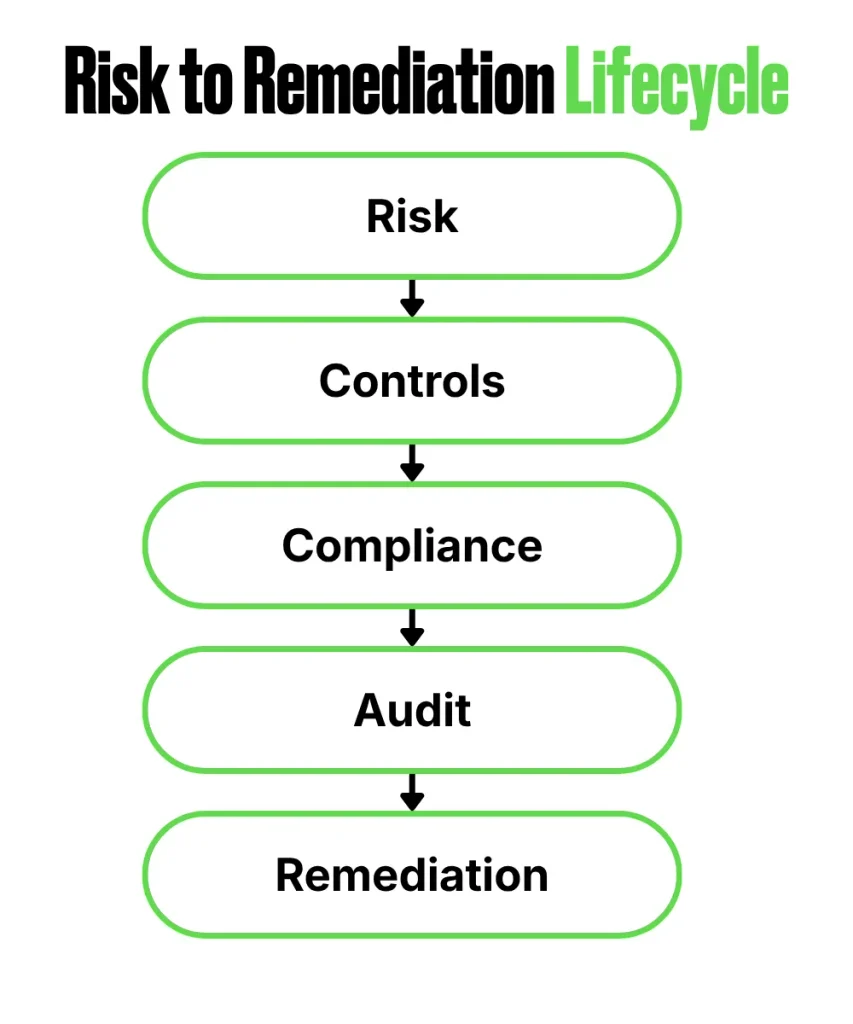
That connected lifecycle is one of the biggest ideas to understand when learning IRM, and that is the power of ServiceNow to make everything work together.
Why Is IRM Becoming More Important?
The need for IRM is growing because organizations are facing more risks than ever before.
Some of the major drivers include:
- Cybersecurity: Increasing cyberattacks and data breaches require organizations to continuously identify and manage security risks.
- Regulations: Regulations such as GDPR and other industry-specific requirements are forcing organizations to demonstrate how they protect data and manage compliance.
- Third-Party Risk: Organizations increasingly depend on vendors and external service providers. A problem with a critical vendor can quickly become a business problem.
- AI: AI introduces a completely new category of risks around data privacy, security, governance, compliance, transparency, and responsible usage. This makes effective risk management even more important.
My Personal Take
Having worked across different areas of the ServiceNow ecosystem, I find IRM particularly interesting because it requires you to think beyond configuration and development. With IRM, it isn’t just about what could go wrong and the impact it could have, but also about how it can be controlled and how it can be prevented in the future.
That shift in thinking makes IRM valuable for anyone looking to move toward consulting, architecture, or strategic ServiceNow roles. I also believe the growing adoption of AI will make this area even more relevant. Organizations won’t just need AI capabilities – they will need to understand and manage the specific risks associated with AI.
I am seeing many organizations move to ServiceNow IRM solutions from legacy tools like Archer, MetricSystem, and many more. I have also seen a lot of new job opportunities coming up for ServiceNow IRM, and this is likely to increase. So, I would highly recommend that everyone learn about IRM to stay relevant in the market.
Here’s my recommended approach for learning about ServiceNow IRM – focus on the following areas:
- Policy and Compliance
- Risk Management
- Audit Management
- Third-Party Risk Management
- Business Continuity Management
You may also want to take a look at the official course on ServiceNow University.
Summary
Ultimately, Integrated Risk Management is about helping organizations make better decisions about risk.
ServiceNow brings together risk, compliance, controls, policies, audits, and organizational information on a single platform, helping organizations move from reactive risk management to a more structured and proactive approach.
If you are a ServiceNow professional who has primarily worked with ITSM or other traditional platform modules, IRM is definitely an area worth exploring, but you don’t have to learn everything at once. Once you understand how all the pieces connect, the ServiceNow IRM ecosystem becomes much easier to understand.
If you want to learn about ServiceNow’s Risk and Compliance (CIS-RC) certification, which is based on ServiceNow IRM, take a look at our companion guide.