





A few months ago, someone asked me a question I have heard often over the years: What is the typical ServiceNow career path? It is a question that comes up regularly, whether from new developers, aspiring architects, consultants looking to specialize, or experienced professionals wondering what comes next.
My answer is always the same: There isn’t only one path, and that is one of the things I find most interesting about the ServiceNow ecosystem. Unlike many technology careers that seem to follow a fairly predictable route, ServiceNow offers multiple paths, multiple destinations, and different ways of defining success.
I have put together an infographic with NowBen to show how I see careers evolving within the ecosystem. It is not intended to be a definitive roadmap. It is simply a reflection of the patterns I have observed over the years while working across development, consulting, architecture, leadership, and mentoring.
More importantly, I don’t see it as a hierarchy. I see it as a map of possibilities because when I look back at the careers of people I’ve worked with, including my own, very few of them followed a straight line.
My Unplanned ServiceNow Journey
Before diving into the infographic, it is worth explaining why I see things this way.
When I started my ServiceNow journey, I was not thinking (or worried) about career paths. I definitely wasn’t thinking about becoming a Technical Architect one day. I joined the ecosystem as an Administrator and Developer during the Eureka era, and like most people starting out, my focus was pretty simple: learn as much as I could and try not to break anything important.
My introduction to the platform was not through a carefully planned development programme or a structured roadmap. I found myself working on a migration initiative involving the logical and physical separation of instances following a corporate spin-off.
Looking back, it was a significant piece of work for someone at the start of their career. At the time, though, all I really knew was that there was a lot to learn and a lot of people who seemed to know far more than I did. I was new to the platform, new to enterprise environments, and regularly found myself with more questions than answers. What I appreciate now is that those early experiences taught me far more than how to configure or develop on the platform.
They were teaching me how organizations make decisions, how technology supports business outcomes, and how platforms become woven into the way companies operate.
Over time, I moved from Developer to Senior Developer, and eventually into a Technical Lead role, leading a team of administrators and developers. That transition was probably one of the biggest learning curves of my career. As a developer, success was largely measured by what I built. As a lead, it became much more about what the team delivered. The focus shifts. The expectations change. And whether you realize it or not, you have to change with them.
As my experience grew, I found myself spending more time helping other projects – reviewing designs, providing guidance, and supporting decisions across teams. I didn’t set out to move into consulting, but that is effectively what was happening. From there, the journey continued into Solution Architecture, Platform Architecture, and eventually Technical Architecture, following my CTA journey.
When I look back now, that is exactly what happened to me – a series of opportunities and challenges that gradually pulled me in new directions, not a plan I was executing. An evolution!
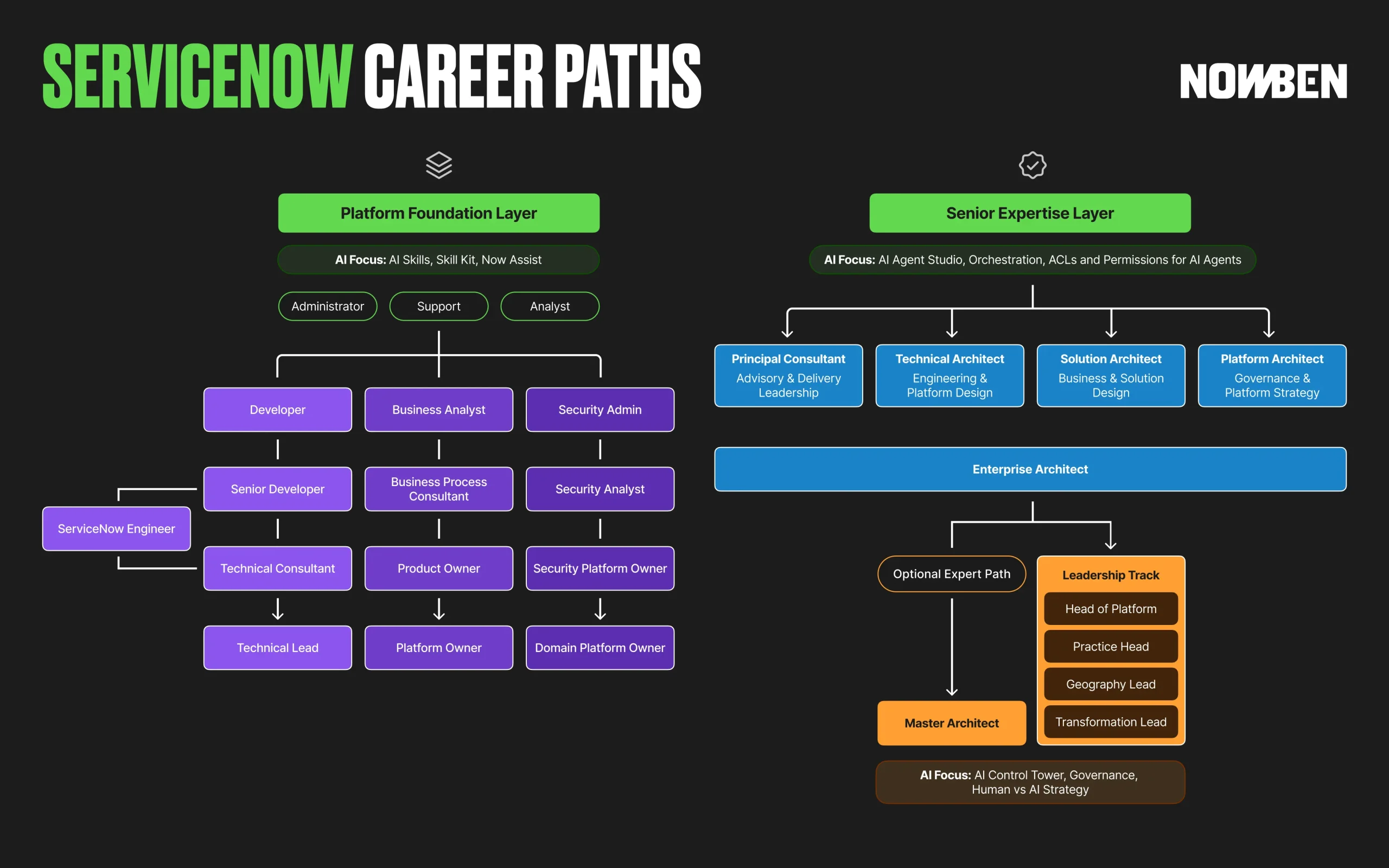
The Platform Foundation Layer
Every career in the ServiceNow ecosystem starts with foundations. Whether your title is Administrator, Developer, Analyst, or Support Specialist, you are learning the same fundamental lesson: How technology creates business value.
This is the stage where professionals learn how the platform works, how requirements become solutions, how incidents become improvements, and how users experience the services we design. You build core knowledge of ServiceNow’s capabilities, data structures, workflows, and configuration tools. This is where formal training and certifications become your most valuable stepping stones.
Core Administration: Starting with ServiceNow Certified System Administrator (CSA), followed by Certified Implementation Specialist (CIS) modules for specific products like IT Service Management, IT Operations Management, or Customer Service Management, etc.
One misconception I occasionally see is people assuming that some entry points are inherently better than others. I don’t believe that is true.
I have worked with exceptional architects who started as developers. I have worked with outstanding platform leaders who started as business analysts. I have worked with consultants who began their careers in support functions.
The starting point matters far less than the capability you build over time.
Where to Start: Practical Tips
If you are at this stage, here is what I would actually tell you to do, rather than what looks good on a CV/resume.
- Get your CSA: What matters is what studying for it does to you. It forces you to sit with the platform long enough to understand its shape, and you need that shape before any of the rest of this makes sense.
- Pick a specialization early: You will probably get it “wrong” the first time. ITSM tends to be where most people land first, mostly because it touches almost everything else on the platform, but I’ve seen plenty of strong careers start in CSM or HRSD instead, depending on where the work actually was.
- Find whoever is most experienced near you and ask to sit in on something: A design review, a change advisory board, anything where decisions get argued out loud rather than handed down. I learned more watching one good argument about a design decision than I did from a month of configuration work on my own.
- Don’t rush this: I still see people trying to get to “architect” within eighteen months, and it rarely goes well. This layer is not something you pass through. It is the thing everything else you build later has to stand on.
The AI System Administrator Career Journey on ServiceNow University is the most structured starting point I would point you toward. It maps out the levels from foundational through to expert, so you can see where you are and what comes next without having to piece it together yourself.
The Technical Path
The most recognizable journey for many professionals is the technical path:
Developer → Senior Developer → Technical Consultant → Technical Lead
This was the path that naturally aligned with my own interests early in my career. What surprised me was how quickly it stopped being purely technical.
- As a developer, you are focused on building and delivering features.
- As a senior developer, you start thinking more about design quality, maintainability, and how your work fits into broader platform standards.
- As a technical consultant, the emphasis shifts again. You are no longer just solving for individual components, you are solving business problems end-to-end.
- As a technical lead, your impact is no longer measured by what you personally build. It comes down to how effectively you enable others to deliver.
We are also seeing organizations introduce ServiceNow Engineer/Platform Engineer roles, focused on reliability, automation, integrations, upgrades, and engineering best practices. Depending on the organization, these often sit alongside Senior Developers or Technical Consultants rather than being a strict next step.
The deeper I progressed, the more I realized that technical expertise opens doors, but communication, collaboration, and influence determine how far those doors open.
Where to Start: Practical Tips
The technical path rewards depth, but it rewards curiosity even more.
As a developer, find something small that is actually yours, start to finish – not a script someone hands you, a real solution people end up using. Watching it go live, get used, and occasionally break teaches you things no course covers.
Somewhere around senior developer, I started asking why more than how. Why this requirement? Why this approach over the other one? That is really what moved me along, more than time served ever did.
If a technical consultant or technical lead is where you are heading, start practising the explanation now. Take a technical decision you have made and explain it to someone with no reason to care about the technical side. If they walk away understanding why it matters, you are closer than you think to being ready for that conversation with a client.
If reliability, automation, and upgrade health interest you more than shipping features, the Platform Engineer path is worth considering. ServiceNow University has dedicated courses for the core skills it demands:
- Upgrade Essentials: The upgrade cycle is one of those things that nobody thinks about until something goes wrong. Understanding it early puts you ahead of most people in this space.
- ATF Essentials: Automated testing is increasingly the line between platforms that upgrade cleanly and ones that don’t. There is also an ATF Micro-Certification worth picking up once you’ve done the essentials.
- Data Foundations — CMDB and CSDM Implementer: if there is one course I would point to as the foundation for everything the industry is heading towards, it is this one. AI agents are only as good as the data they reason over. Autonomous workflows are only as trustworthy as the CMDB that tells them what exists, what depends on what, and what the business actually looks like. Organizations that skip data foundations and jump straight to AI will hit a ceiling quickly, and the people who understand why will be the ones asked to fix it. This path is relevant regardless of which direction your career takes, and its importance is only going to grow.
The AI Application Developer Career Journey on ServiceNow University is worth bookmarking early. It is structured by job level, so it grows with you rather than becoming irrelevant once you have got the basics. And once you have got your CSA, the ITSM Implementer learning path is the one most technical careers end up running through sooner or later – it is worth doing for the way it forces you to think in processes, not just configuration.
The Business Path
Not every successful ServiceNow professional follows a technical route. Some of the most impactful people I have worked alongside have been those who excel at understanding organizations, processes, and stakeholder needs.
This journey often evolves from Business Analyst to Business Process Consultant, Product Owner, and ultimately Platform Owner. These individuals become the bridge between business ambition and platform capability.
They are often asking different questions from the technical path – should we build this, not can we. That distinction matters more as organizations mature.
This is often where many people start their journey in the ServiceNow ecosystem. Business Analysts spend time understanding how an organization works, capturing requirements, mapping processes, and identifying opportunities where the platform can create value.
A strong Business Analyst brings curiosity and context – understanding the challenges people face today and helping shape better ways of working.
Where to Start: Practical Tips
The thing that actually grows you in this role is not more platform knowledge. It is getting better at noticing when what someone is asking for and what they actually need are not the same thing. Pay attention to the next time you are in a requirements session. Half the room will describe the symptom, not the problem. Learn to spot the gap, and you will already be ahead of most people doing this job.
It is also worth asking why a process looks the way it does, not just what it does. More often than you would expect, nobody in the room actually knows, and being the one who goes and finds out is genuinely valuable.
The AI Business Process Analyst Career Journey on ServiceNow University covers both the BA and Business Process Consultant levels, so it is a useful thread to follow as you move along this path rather than needing to find a new starting point each time.
Business Process Consultants take a broader view of how work moves through an organization.
They focus on improving processes, removing inefficiencies, and helping teams rethink how services are delivered.
The role requires a balance of business understanding, process knowledge, and the ability to see where ServiceNow can support meaningful change.
Where to Start: Practical Tips
Moving into this role means widening your view on purpose. Stop looking at one process by itself and start tracing what feeds into it and what it feeds into afterwards. Inefficiency rarely lives inside one step. It hides in the handoffs between them.
Measure before you propose changing anything. “This feels slow” does not get you very far in a stakeholder conversation. “This takes eleven days and four approvals” does.
Product Owners help define the direction and priorities of a ServiceNow capability. They work closely with stakeholders, users, and delivery teams to make sure the platform continues to evolve and deliver value.
The role requires making decisions, managing competing priorities, and keeping the focus on outcomes rather than simply delivering features.
Where to Start: Practical Tips
This role is really a shift from gathering requirements to making trade-offs, and that is a harder shift than it sounds. Start practising saying no to ideas that are genuinely good but aren’t the priority right now – that is most of what prioritization actually is.
Get comfortable putting a roadmap in front of people publicly, including the bits that are still wrong or likely to change. I have seen Product Owners lose credibility hiding behind “still finalizing it” far faster than the ones who just say “here is where we are, and here is what could shift it.”
Platform Owners take responsibility for the long-term success of the ServiceNow platform. They focus on strategy, governance, adoption, and ensuring the platform continues to support the changing needs of the organization.
Their decisions shape how the platform grows, how it is used, and the value it delivers over time.
Where to Start: Practical Tips
This is a strategy and governance role long before it is a technical one, so start building those muscles wherever you currently sit. Sit in on governance forums even when nobody has asked you to. Understand how adoption actually gets measured in your organization, not just how it is supposed to be measured.
Try thinking three years out instead of three sprints out, even informally. What does the platform need to look like by then, and can you already explain why? If you can answer that with some confidence, you are closer to this role than you might think.
ServiceNow University has a dedicated AI Platform Owner Career Journey that maps this role from foundational through to strategic – worth going through not just for the content but because it gives you a vocabulary for the conversations this role is built on.
The Security and Governance Path
As ServiceNow platforms become larger and more business-critical, governance, risk, and security become increasingly important.
This creates another highly valuable career path:
- Security Administrator
- Security Analyst
- Security Platform Owner
- Domain Platform Owner
A quick note before diving into this one: the Security and Governance path is younger than the other routes in this guide, and it is moving fast, largely because AI is forcing governance to mature faster than the rest of the platform has had to. What follows is my read on where it is heading, based on what I am seeing right now, not a settled map the way the Technical or Business paths are.
Security Administrators are often the foundation of this journey. They focus on the day-to-day security of the platform – managing access, roles, permissions, configurations, and ensuring the right people have the right level of access.
This role requires attention to detail, a strong understanding of the platform, and an appreciation of how security decisions impact the wider organization. These professionals provide the structure that allows platforms to scale safely and sustainably. While they may not always receive the same visibility as developers or architects, their contribution becomes increasingly important as enterprise complexity grows.
Where to Start: Practical Tips
I’ll be honest – security roles on ServiceNow are more underestimated than almost any other path I have seen. People assume it is mostly access management and permissions work. In my experience, the people who go deep here end up with a scope and a level of trust that takes developers years to build.
The first thing worth getting comfortable with is the access model – not just how to configure it, but why it is built the way it is. Roles, ACLs, the difference between what someone can do and what they should be allowed to do. That distinction sounds simple. Getting it wrong is how platforms get compromised.
There are two sides to security work on ServiceNow, and it is worth knowing both early. SecOps – Vulnerability Response, Security Incident Response, Threat Intelligence deals with threats coming from outside the organization and flowing through the platform. The Security Center is about securing the platform itself: misconfigurations, unusual access patterns, exposure that could compromise the instance before any external threat even arrives. In some organizations, the Security Administrator owns both sides.
The Australia release made this more interesting. Security Center now ships with granular, dedicated roles, so for the first time admins can manage hardening recommendations, review access anomalies, and track remediation tasks without needing full admin access at all. That matters in regulated environments, where full admin exposure has always been a governance problem. Access Analyzer is now built directly into the Security Center, and the hardening recommendations are version-aware – contextual to your instance rather than generic. You can also formally accept or exempt a recommendation that doesn’t apply to your organization, with a mandatory justification and a projected impact on your security score.
For Security Admins, this is definitely a meaningful shift. The role is moving from reactive configuration to proactive governance, and the Australia release tooling is built specifically to support that.
The Introduction to ServiceNow Security Center on ServiceNow University is a two-hour on-demand course that builds the vocabulary early – worth doing before you are asked to configure it under pressure. Pair it with the Security Operations Fundamentals course, which covers the SecOps side and is the prerequisite for both the CIS-VR and CIS-SIR paths. Together, they give you a view of the full landscape rather than just one side of it.
Security Analysts take a broader view, looking beyond individual configurations and focusing on risk, controls, vulnerabilities, and security improvements. They help organizations understand where exposure exists and how the ServiceNow platform can support stronger security practices.
The role combines technical knowledge with investigation, analysis, and a strong understanding of organizational risk.
Where to Start: Practical Tips
The thing that moves you forward in this role more than anything else is learning to talk about risk in business terms, not technical ones. “This configuration is wrong” is an admin observation. Here’s what could actually happen if we leave it” is an analyst’s conversation. That difference is what gets you taken seriously in the rooms that matter.
What I find interesting about where this role sits right now is that you are living on both sides of the inside/outside split I mentioned back in the Security Administrator section, and most people focus heavily on one and underinvest in the other.
This role got meaningfully broader with the Australia release, too. AI asset security controls are now part of the platform: policy monitoring for AI capabilities, PII detection, visibility into how AI agents are interacting with data. The Vault Console brings data classification and policy enforcement into one place. What that means practically is that as organizations start running more AI agents, the security analyst is increasingly the person being asked whether those agents are operating safely. That’s a new question for most people in this role, and not many have a good answer yet. If you start building that knowledge now, you’ll be ahead of most of the market.
For the SecOps certifications, the Vulnerability Response Implementer path and the Security Incident Response path are both on ServiceNow University. Pick whichever one reflects the work you are actually doing. And if you haven’t spent time with the Introduction to Security Center yet, I would go back and do that – it changes how you see the other half of the job.
Security Platform Owners take ownership of the security capability within ServiceNow. They focus on strategy, governance, roadmap planning, and ensuring security solutions continue to evolve alongside the organization’s needs.
Their role is about creating confidence in the platform – making sure security is built into the way the organization operates.
Where to Start: Practical Tips
By the time you reach this role, you already understand the tooling. What changes here is accountability. You are no longer the person who runs the controls. You are the person who decides what the controls should be, explains why they exist, and owns the conversation when something goes wrong.
The shift that catches people out is how outward-facing this role really is. You end up spending a lot of time with stakeholders who don’t care about the platform itself. They care about risk, compliance, and whether the business can keep operating safely. Learning to translate between the two is most of the job.
One specific change is worth flagging here. AI Control Tower now sits here, covering governance, security, and measurement of AI across the entire enterprise, not just ServiceNow-native capabilities. That means Security Platform Owners are increasingly being asked to own the question of whether AI is operating safely and within policy, not just whether the platform is secure. It’s a genuinely new responsibility, and the organizations that figure it out early will have a real advantage. Being the person who can own that conversation, technical enough to understand the controls, and senior enough to set the strategy, is where this role is heading.
Domain Platform Owners operate at an even broader level, taking responsibility for a specific capability area and its long-term direction. They bring together business needs, platform capability, governance, and continuous improvement to ensure the domain delivers lasting value.
The role requires a balance of strategic thinking, stakeholder engagement, and a deep understanding of how the platform supports the organization.
Where to Start: Practical Tips
The Domain Platform Owner role is often the least understood on this path, and I think that is because it sits at an unusual intersection. You are not just owning security – you are owning an entire capability domain, whether that is GRC, ITOM, or another area, and security is one lens through which you govern it.
What that means in practice is that the conversations are different. You are thinking about how the domain serves the organization long term, how it connects to adjacent capabilities, and how security, compliance, and governance sit inside a broader operating model rather than as standalone concerns.
The people who thrive here are the ones who have deliberately built breadth across their careers – not just deep technical knowledge, but genuine understanding of how the business operates, how risk decisions get made, and how platforms create lasting value. If you are on this path, start thinking about the domain you want to own and go learn it properly – not just the ServiceNow capability, but the business process underneath it. That combination is what makes this role hard to find and well rewarded when you do find it.
The Point Where Careers Begin to Converge
One of the reasons I structured the diagram the way I did is that I don’t see architecture as simply another promotion. I see it as a convergence point.
At some stage in your career, technical expertise alone is no longer enough. Business knowledge alone is no longer enough. Governance knowledge alone is no longer enough. The challenges become broader. The decisions become more consequential. And perspective becomes more important than specialisation. This is where many professionals begin moving into what I describe as the Senior Expertise Layer.
The Layer That Is Changing Everything
Before we talk about senior expertise, there is something that anyone thinking about a ServiceNow career right now needs to understand. The platform is changing faster than at any point in its history.
When I started in the Eureka era, the question was: can ServiceNow do this? Today, increasingly, the question is: should a human be doing this at all?
ServiceNow has introduced what it calls an Autonomous Workforce – AI specialists that don’t assist with work, but complete it end-to-end. The first of these targets Level 1 Service Desk functions. Password resets, software provisioning, network troubleshooting – tasks that have formed the entry point of many technical careers are now being handled autonomously. ServiceNow’s own internal deployment resolves the vast majority of employee IT requests without human involvement.
The careers I have described throughout this article don’t disappear. But some of the rungs on the early ladder are changing shape. And that has implications for how you build your foundation.
What Does This Actually Mean For Your Career?
The professionals who will thrive in this shift are not necessarily those who know the most about how AI works. They are the ones who understand what AI cannot yet do well and build their expertise there.
AI can resolve a ticket. It cannot understand why an organization keeps generating the same tickets in the first place. AI can execute a workflow. It cannot judge whether that workflow should exist. AI can govern its own actions within defined parameters. It cannot define what the right parameters are for a business it has never understood.
This is why the business acumen, process thinking, stakeholder influence, and architectural judgment I have described throughout this article are not becoming less valuable. In many ways, they are becoming more valuable because they are precisely the capabilities that autonomous systems depend on humans to provide.
The New Skills Worth Building Alongside Your Core Path
Regardless of which path you are on, there are a small number of capabilities that are becoming genuinely differentiated in the current ecosystem: Understanding how to design, configure, and govern AI agents within ServiceNow, particularly through tools like Now Assist, AI Agent Studio, and the AI Control Tower, is moving from specialist knowledge to baseline expectation faster than most people realize.
Understanding what makes an agentic workflow trustworthy – how to define guardrails, audit trails, escalation logic, and governance policies is a skill that sits at the intersection of technical and business knowledge. Very few people currently have it well. That gap is an opportunity.
And perhaps most importantly, the ability to advise organizations on where AI should be deployed, where human judgment should remain central, and how to manage the transition – that is becoming one of the most sought-after capabilities in the entire ecosystem.
That last one sounds like architecture. Because it is.
Where to Start: Practical Tips
You don’t need to become an AI specialist here. You need enough fluency to hold a real conversation about it.
Go and use Now Assist or AI Agent Studio yourself, even in a developer instance. Reading about it gets you nowhere near as far as an hour actually doing it. Start with Introduction to Generative AI on ServiceNow University – it is the current entry point for understanding how Now Assist works across the platform, and it sets up everything else. Once you have done that, Introduction to Agentic AI is the natural companion – a short course specifically covering AI agents, how they are different from GenAI, and why that distinction matters in practice.
One other thing worth knowing: ServiceNow announced at Knowledge 2026 that Now Assist is being brought together with Moveworks into a single experience called Otto. The underlying capability is the same – knowing that the branding is shifting helps you follow what is happening without getting confused by the naming.
Pick one repetitive thing near you right now and genuinely work through whether AI should be doing it – what guardrails it would need, where a human still has to stay in the loop. If you want to make that exercise real rather than theoretical, the Build an AI Agent hands-on lab on ServiceNow University puts you through exactly that process – building an agent, defining its boundaries, and seeing where the decisions actually get hard. One session like that will teach you more than any amount of reading about it.
If you are early in your career, I wouldn’t panic about the entry-level work changing shape. I would make sure you’re building the things AI doesn’t touch, alongside whatever else you are learning – understanding why a process exists, reading a room, making a call with half the information you would like to have. Those don’t show up on a certification blueprint, and they are exactly what I meant earlier about this kind of judgment mattering more, not less. The AI Essentials learning path is a good foundation if you want a structured way into the topic – it covers AI fundamentals, responsible use, and how to apply it practically, without assuming you are coming in as a developer or architect.
The Senior Expertise Layer
Over the years, I have worked with many different types of architects and consultants. Over time, I realized that architecture means different things depending on the challenges an organization is trying to solve.
There is no single architectural lens. Different roles provide different perspectives, helping organizations make the right decisions at the right time.
These individuals often focus on advisory engagements, delivery leadership, transformation initiatives, and executive relationships. Their influence extends beyond technology and into organizational change.
Where to Start: Practical Tips
This role lives in advisory and delivery leadership, so start practising both now, wherever you are. Put yourself forward for the client-facing parts of whatever you are working on, especially the uncomfortable ones – the moments where you have to deliver something nobody wants to hear.
Get into the habit of writing down the reasoning behind recommendations you make, even informally. When you are eventually defending a transformation roadmap to an executive, that habit is most of what you will be drawing on.
This is the route I eventually pursued. Technical Architects focus on platform engineering, integrations, scalability, technical governance, and ensuring solutions remain robust as organizations grow.
The role requires depth, but it also requires breadth. You need to understand technology, but you also need to understand why the technology exists in the first place.
Where to Start: Practical Tips
If this is your route, start going broad on purpose, not just deep. Pick something outside your comfort zone – integrations if you have mostly lived in workflow, scalability if integrations are your home, and get genuinely competent in it, not just familiar.
In every design decision, I would start by asking what happens when this needs to scale ten times over, or survive an acquisition, or outlive the person who built it. That question is most of what technical architecture turns out to be.
When you feel ready to formalise that, the pathway now goes through two steps. ArchX — Architecture Excellence is the right starting point – a cohort-based programme designed for early- to mid-level architects with around one to three years of experience, focused on architectural patterns, standards, and long-term platform health.
It requires your CSA and at least one CIS, and as of 2026, ServiceNow has formalized it as the staging ground for the expert-level credentials. From there, the CTA Expert Program is a 12-week cohort that prepares you for the capstone exam.
One thing worth knowing: the CTA exam itself is currently in transition – the previous version retired in May 2026 and a new version is being rolled out. Check the Expert Programs page for current cohort dates and the updated requirements before you register, since the details are actively changing.
Solution Architects sit at the intersection of business needs and platform capability. Their strength lies in translating complex requirements into practical and achievable solutions. They help organizations move from ideas to outcomes.
Where to Start: Practical Tips
Practice the translation deliberately. Take a business requirement you have been handed and sketch two versions of the solution – the ideal one, and the one that’s actually achievable, and get comfortable explaining the gap between them honestly.
Spend more time on the business side of your projects than your current role strictly requires. The earlier you understand what “good” looks like to a stakeholder, the better your solutions fit before you’ve even started building.
Platform Architects focus on the long-term health of the platform itself. They think about governance, operating models, standards, roadmaps, and strategic direction. Their horizon is often measured in years rather than projects.
Where to Start: Practical Tips
This role thinks in years, so start practising that horizon now, even in small ways. Whenever you make a decision today, ask what it will cost the platform if it’s wrong in three years.
Get involved in governance and operating model conversations before it is officially your job. Anyone can draw a roadmap. A roadmap that survives three reorgs and a CFO change is a different skill entirely, and you only really build it by watching that happen a few times before you are the one accountable for it.
If you are exploring whether this is the direction you want to go, ServiceNow University has a short course specifically on this – What Does a Platform Architect Do? – this is not just to learn the job, but to check whether how it is described matches what actually energizes you.
Why Enterprise Architecture Sits in the Middle
One aspect of the diagram that people often notice immediately is the position of the Enterprise Architect. It is not placed above the other architectural disciplines – it is positioned between them. That was intentional.
I don’t see Enterprise Architecture as a superior role. I see it as an integrative role. The best Enterprise Architects I’ve worked with have usually developed an appreciation for technology, business, governance, delivery, and organizational strategy. They understand how decisions in one area influence outcomes in another. Enterprise Architecture is not so much about having every answer as it is about bringing the right perspectives together.
Where to Start: Practical Tips
You don’t prepare for this by getting better at one discipline. You prepare by deliberately collecting the others.
If you are technical, go sit in on business and governance conversations you are not required to attend. If you are business-focused, go understand the technical constraints behind the decisions you are shaping. The goal is not to become an expert in everything – it is enough fluency across the board that you notice when a decision in one area is quietly breaking something in another.
The question worth practising is the one that defines this role: not “is this the right answer,” but “whose perspective am I missing right now?”
Beyond Enterprise Architecture: Two Diverging Paths
One thing I have consistently seen in the ecosystem is that careers don’t stop at Enterprise Architect. They evolve in two very different directions depending on what energizes you the most.
For some of us, the journey continues deeper into technical and architectural mastery.
In the ServiceNow ecosystem, this often aligns with the Certified Master Architect (CMA) path.
This is not just a certification milestone. It represents a very specific kind of professional evolution.
At this stage, the focus shifts away from individual solutions or even single-platform decisions.
You’re now dealing with:
- Complex enterprise landscapes.
- Multi-instance or multi-platform architecture.
- Large-scale transformation programmes.
- Cross-domain design decisions.
- Long-term architectural sustainability.
What changes here is not just scope, but thinking. You stop asking: “How do we build this?”
And start asking: “Should this exist at all, and how does it fit into everything else?”
From my own experience moving through architecture into CTA and deeper advisory work, this direction is not about knowing more features. It is about learning how to simplify complexity without losing intent. You become someone who is brought in when the problem is no longer technical in isolation, but architectural, organizational, and strategic at the same time. That is what makes this path distinct.
It is not about being the smartest person in the room. It is about being the one who can see across silos, when everyone else is focused on their part of it.
Where to Start: Practical Tips
This path rewards people who can simplify complexity without losing what made it complex in the first place. Start practising that on a smaller scale now. Take the most complicated thing in your current environment and try explaining it in five sentences to someone with zero context. If you can’t, you probably understand it less than you think, and that is worth knowing early.
Look for chances to work across instances, platforms, or genuinely cross-domain problems, even informally. CMA is not really about the exam. It is about whether you have built the instinct to see the whole system when everyone around you is heads-down in their own piece of it, and that instinct only comes from putting yourself in front of systems bigger than your role technically requires.
The Expert Programs page on ServiceNow University covers both CTA and CMA in one place – worth reading the CMA entry in detail, because the prerequisites and the process are more specific than most people expect before they start looking into it seriously.
Others discover that their greatest impact comes through people rather than platforms. They move into leadership positions such as Head of Platform, Practice Lead, Geography Lead, or Transformation Lead. Their focus shifts towards building teams, developing talent, shaping strategy, and creating environments where others can succeed.
Neither path is inherently better. They simply optimize for different strengths.
Where to Start: Practical Tips
If people, not platforms, are what energize you, you don’t need a title to start finding that out. Mentor someone, even informally, and pay attention to whether you get more satisfaction from solving the problem yourself or from helping them become capable of solving it themselves. That is usually the clearest signal of which path actually fits.
Practice the harder people conversations early – performance, direction, disagreement – at whatever scale you currently have, even if it is one person. Leadership at scale ends up being the same skill as leadership of one, just repeated under more pressure and higher stakes.
The Advice I Wish I Had Earlier
If there is one thing I have learned throughout my journey, it is that careers rarely unfold exactly as planned. Most opportunities arrive disguised as challenges. Most growth happens slightly outside your comfort zone. And many of the skills that ultimately define your career are not listed in certification blueprints.
Learn the platform deeply. But also learn how businesses operate. Learn how to communicate. Learn how to influence. Learn how to listen. Learn how to lead. The higher you progress, the more those skills matter.
Most importantly, don’t become overly focused on chasing titles. Focus on building capability. Titles tend to follow.
Architecture is not the end of technical growth. It is a shift in responsibility.
And what comes after it depends entirely on how you define value:
- Depth of expertise → Certified Master Architect path.
- Breadth of influence → Leadership path.
Both are valid. Both are needed. Both shape the ecosystem in very different ways.
Final Thoughts
When I look back at the developer who first encountered ServiceNow during the Eureka era, I don’t think I would have predicted any of this. I certainly wasn’t thinking about architecture frameworks, CTA boards, platform strategy, or career diagrams.
I was trying to solve the problem in front of me. And perhaps that is the biggest lesson of all.
Careers are rarely built through perfect planning. They are built through curiosity, consistency, learning, and saying yes to opportunities that stretch you.
The infographic in this guide represents one way of visualizing the possibilities that exist within the ServiceNow ecosystem. Not a definitive path. Not a prescribed journey. Simply a reminder that there are many ways to grow, many ways to contribute, and many ways to build a meaningful career.
Your starting point may be similar to someone else’s. Your destination doesn’t have to be.
Comments: