





If you’re looking to build a career in the ServiceNow ecosystem, there’s a good chance you’ll find yourself taking a ServiceNow certification exam sooner or later. This is one of the best ways to prove your expertise and credibility, since the syllabi are directly built by ServiceNow itself.
The certifications come in a wide variety of shapes, sizes, and difficulties – meaning there’s almost certainly something for everybody here. They are widely recognized and respected across the ServiceNow ecosystem and are often a prerequisite for many ServiceNow-specific roles and opportunities. So where do you start?
ServiceNow Certifications Infographic
ServiceNow offers a wide range of certifications designed for learners at different stages of their career journeys. Some can be completed by relative beginners after studying a few courses through the ServiceNow University. But others require you to have already completed another certification before you can qualify.
To help you visualize these prerequisites, we’ve created this infographic:
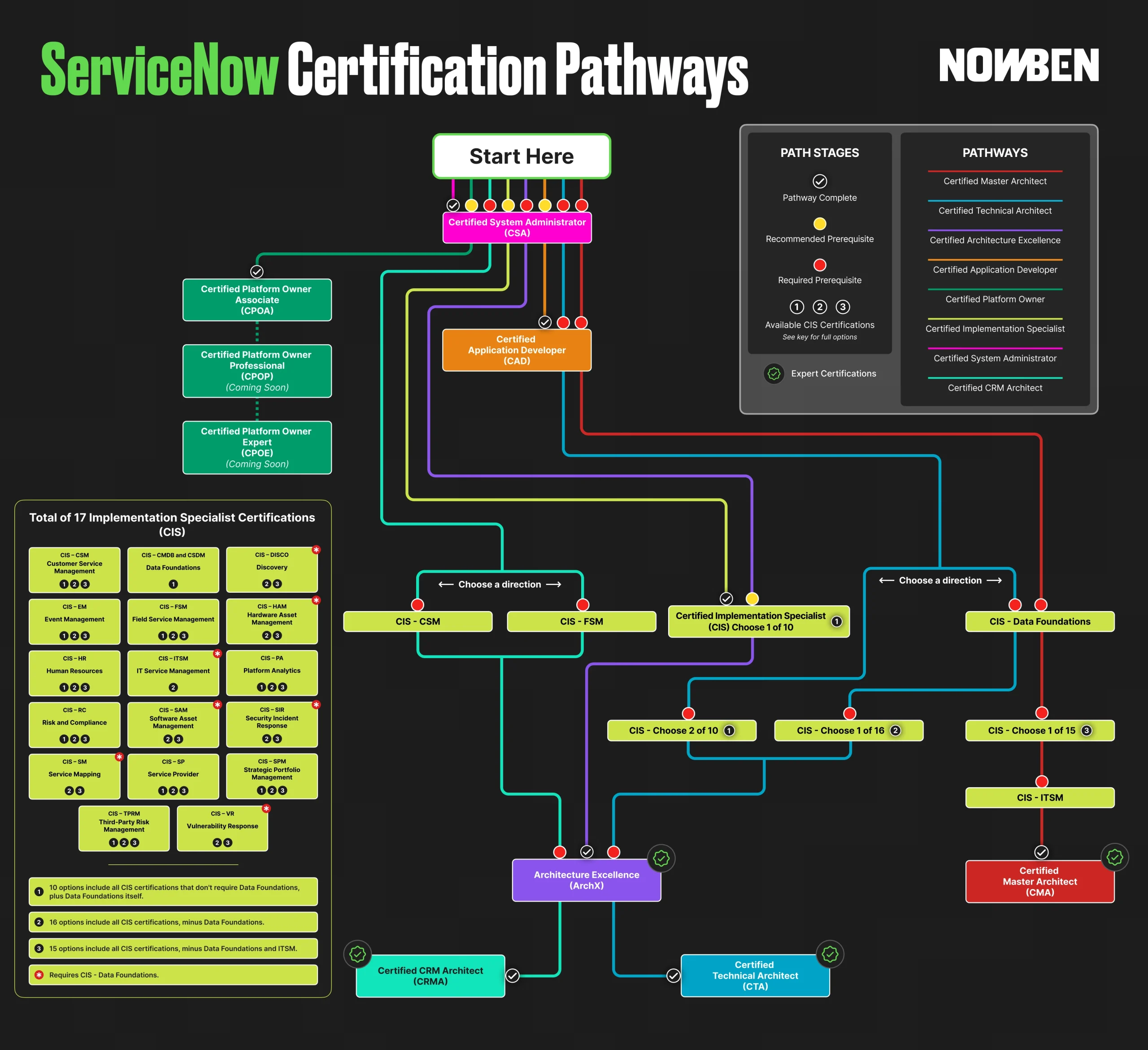
At a Glance: A Guide to ServiceNow Certifications
Like many aspects of the ServiceNow ecosystem, certifications can be a bit tricky to get your head around at first glance. That’s because there are various types of exams, each with their own prerequisites, formats, and requirements:
- Accreditation: These are awarded upon passing a short, non-proctored exam. They are free and can be completed easily online. These are not pictured in the infographic above.
- Micro-certification: Very similar to accreditations, these certificates are also awarded after completing a short online exam or simulator assessment. These tend to focus more on technical skills than accreditations. These are not pictured in the infographic above.
- Suite: A Suite certification is automatically achieved when the required underlying requirements are complete – generally including other micro and mainline certifications. There is no additional exam to complete. These are not included in the infographic above.
- Mainline: Also referred to as ‘High-Stakes’ certifications, these are the most important and common certifications. They are paid ($300-$450), proctored exams. Most mainline certifications can be completed without having an existing certification – though Certified System Administrator is generally considered the best starting point.
- Expert: The highest level of SN certification. These are paid ($2,500-$17,000) and require participants to have extensive ServiceNow-specific experience and existing certifications.
Of these five categories, the most important by far are the mainline and expert certifications, both of which are included in the infographic above. If you want to demonstrate meaningful skills and expertise, these are the places to go.
At a Glance: Full List of ServiceNow Mainline and Expert Certifications
Here is the full list of prerequisites for each mainline and expert certification. See the ServiceNow guide here for the full list.
While the information in this table is correct at the time of writing, the ServiceNow certification landscape is constantly changing, with courses and prerequisites being regularly added and removed. Therefore, it’s important to check the ServiceNow Credentialing Program Guide before embarking on a pathway.
| Certifications | Prerequisites |
| Certified System Administrator (CSA) | – |
| Certified Application Developer (CAD) | Certified System Administrator¹ |
| Certified Platform Owner (CPO) | Certified System Administrator¹ |
|
|
| Certified Implementation Specialist – All others (10 total) | Certified System Administrator¹ |
| Architecture Excellence (ArchX) |
|
| Certified CRM Architect (CRMA)² |
|
| Certified Technical Architect (CTA) |
|
| Certified Master Architect (CMA) |
|
- Recommended
- Now available
- Since CIS-Data Foundations is a prerequisite for CIS-ITSM, you must hold this as well, though it’s not an ‘official’ prerequisite for CMA.
Certified Implementation Specialist: Which Course to Study?
As you’ll have noticed in the infographic above, there are a lot of Certified Implementation Specialist (CIS) courses. At the time of writing, there are 17 total.
For all intents and purposes, these are exactly the same as other mainline certifications like Certified Application Developer. However, they are specific to different ServiceNow products and modules. This means the course you’ll study will be different depending on the technology you’re looking to specialize in.
In the vast majority of cases, it makes little difference what course you study, and you can choose whichever is best suited for your career goals or organization.
However, one of these CIS certifications is now a prerequisite for several others. As of 2026, you now have to complete CIS–Data Foundations before you qualify for seven other CIS certifications. If you’re unsure which CIS course to start with, Data Foundations could well be a good option, since it opens the door to these other courses. See the full list above for more details.
Most expert certifications require you to have completed at least one CIS course, but don’t specify which one. For ArchX, a single CIS certification is recommended, but not required. The only other exception is the Certified Master Architect, which requires you to have completed the CIS-ITSM certification along with two others of your choice. However, given that Data Foundations is a prerequisite for CIS-ITSM, in practice, it is likely to be one of your two chosen ITSM certifications as well.
Here is the full list of Certified Implementation Specialist courses at the time of writing:
- Certified Implementation Specialist – Customer Service Management (CIS–CSM)
- Certified Implementation Specialist – Data Foundations (CMDB and CSDM)
- Certified Implementation Specialist – Discovery (CIS–DISCO)
- Certified Implementation Specialist – Event Management (CIS–EM)
- Certified Implementation Specialist – Field Service Management (CIS–FSM)
- Certified Implementation Specialist – Hardware Asset Management (CIS–HAM)
- Certified Implementation Specialist – Human Resources (CIS–HR)
- Certified Implementation Specialist – IT Service Management (CIS–ITSM)
- Certified Implementation Specialist – Platform Analytics (CIS–PA)
- Certified Implementation Specialist – Risk and Compliance (CIS–RC)
- Certified Implementation Specialist – Security Incident Response (CIS–SIR)
- Certified Implementation Specialist – Service Mapping (CIS–SM)
- Certified Implementation Specialist – Service Provider (CIS–SP)
- Certified Implementation Specialist – Software Asset Management (CIS–SAM)
- Certified Implementation Specialist – Strategic Portfolio Management (CIS–SPM)
- Certified Implementation Specialist – Third-Party Risk Management (CIS–TPRM)
- Certified Implementation Specialist – Vulnerability Response (CIS–VR)
ServiceNow Certifications: Where to Start?
As you’ll have noticed, there are a lot of certifications on this list. And when you expand the list to include suite and micro-certifications, accreditations, on-demand courses, and more, the picture starts to look very complex.
If you’re just starting, you might therefore be wondering which path or approach is right for you. Here are some thoughts to help:
- Getting started with ServiceNow: If you have no knowledge or experience whatsoever, the ‘Welcome to ServiceNow’ on-demand course is the place to go, as it will give you all the basics in a quick and digestible format. This is good training for most mainline certifications.
- Preparing your first exam: If you’re eyeing up a ServiceNow mainline certification, it’s helpful to develop your skills further through the ServiceNow University before getting started. Though there are far too many on-demand courses to list here, the following regularly feature as recommended training for mainline certifications: ServiceNow Administration Fundamentals, Scripting in ServiceNow Fundamentals, Application Development Fundamentals On Demand, Get Started with Now Create, ServiceNow Platform Implementation.
- Your first certification: Certified System Administrator will almost certainly be the first certification you complete, as it’s by far the most common and fundamental option. If you’re just looking to gain and demonstrate general ServiceNow expertise, this is almost certainly the one for you.
- Taking it to the next level: From here, the opportunities are endless and will vary hugely depending on your career goals and experience. If you’re looking to develop skills in a specific niche, you may want to explore additional mainline certifications. And if you want to really stand out, then expert certifications might well be for you.
If you want to find out more about ServiceNow learning courses or pathways, check out our recent post covering the ServiceNow University. In the meantime, best of luck with whatever exam you’re aiming for.
For tips on how to prepare for a ServiceNow certification exam, download our free eBook “How to Prepare for a ServiceNow Certification”: