





Today, ServiceNow announced Autonomous Workforce, a brand new agentic AI product that enables organizations to deploy role-specific AI ‘specialists’. These tools will have defined roles and responsibilities and be able to “execute specific jobs within the scope, authority, and governance required for enterprise work”.
The release marks a new stage in ServiceNow’s ongoing mission to become the ‘operating system for AI-powered enterprises’. As such, the company has taken explicit aim at other AI vendors whose products can ‘summarize and recommend’ – but can’t automate tasks and roles in any meaningful sense.
Autonomous Workforce was announced alongside another new ServiceNow product: EmployeeWorks, a conversational AI and enterprise search tool based on technology from the recently-acquired Moveworks.
Introducing Autonomous Workforce

“Businesses don’t need more pilots or promises. They need AI that gets work done…
“Our platform was purpose-built for this moment. Autonomous Workforce augments human teams with AI specialists that operate with the scope, authority, and governance enterprise work demands. This is a new era of productivity and ROI, at scale.”
Amit Zavery, President, Chief Product Officer, and Chief Operating Officer, ServiceNow
The first example of Autonomous Workforce is set to be released for general availability in Q2 2026: L1 Service Desk AI Specialist. Effectively, this acts as the prototype for the wider product. It is designed to complete common IT support requests, such as password resets, software access provisioning, network troubleshooting, and more. As such, it aims to eliminate repetitive and high-volume tasks, reducing manual work and speeding up resolution times for busy IT teams.
Crucially, it aims to automate processes, not just tasks. As such, the L1 Service Desk AI Specialist is specifically designed to:
- Diagnose problems
- Determine the right resolution path
- Take corrective action
- Close the incident
- Notify affected employees and update the knowledge base
To do this, it draws heavily on existing ServiceNow functionality and information stored in the Configuration Management Database (CMDB), as well as knowledge bases, historical incident data, and proactive remediation workflows. This aims to give the specialists oversight over as much contextual information as possible, so they can effectively diagnose problems and determine the right resolution path.
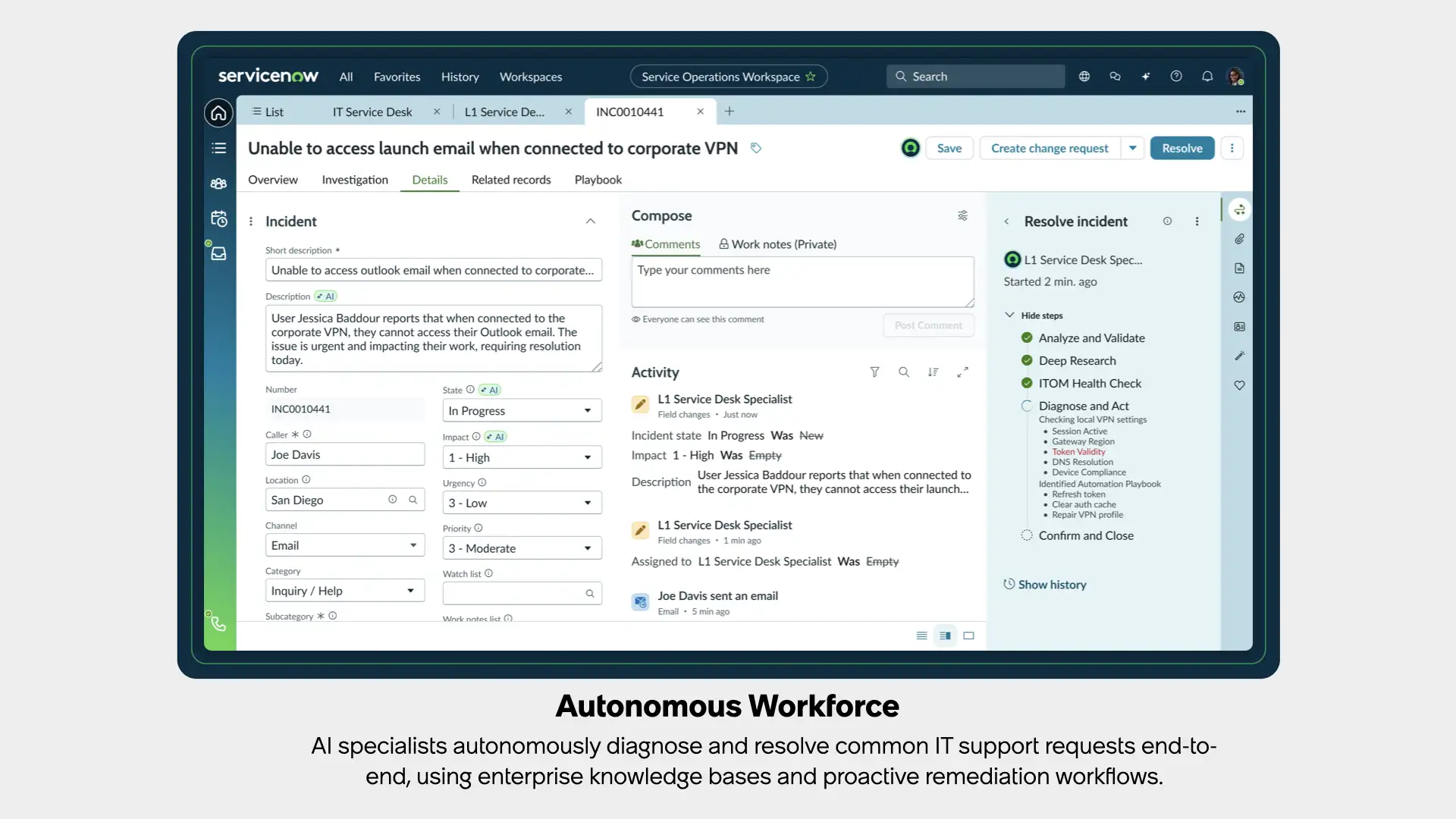
This information includes details about assets, ownership, real-time permissions, and previous resolutions. This gives ServiceNow something of a USP in the AI space. While AI agents and models are increasingly common, few vendors have the same heritage as ServiceNow.
The L1 Service Desk AI Specialist is just the first example of one of these roles. In the future, others might include Employee Service Agents, Security Operations Analysts, or Autonomous AI Developers.
How Autonomous Workforce Maintains a Security-First Approach
ServiceNow’s AI strategy so far has put a great deal of emphasis on governance and security considerations. Unsurprisingly, this was a big running theme of the new product’s launch. As such, the vendor took great pains to reinforce the tight security controls that exist around these new AI specialists:
- Autonomous Workforce specialists are fully traceable and follow policies that are already established in the ServiceNow platform itself.
- They also operate within a clearly defined scope and are unable to stray beyond this. This involves avoiding critical issues like overlapping entitlements (or ‘toxic combinations of entitlements’), which could create loopholes.
- By default, AI specialists cannot exceed their authority nor self-escalate permissions, even if their own logic or reasoning deems it necessary to complete the task.
- All policies are defined and governed through the AI Control Tower.
Collectively, these policies aim to ensure Autonomous Workforce specialists operate within a strict and tightly defined scope.
Where Does Autonomous Workforce Fit in the Wider ServiceNow Portfolio?
The technology underpinning Autonomous Workforce is not new. In fact, it builds on the same fundamental technology that ServiceNow has already rolled out through tools like Now Assist AI agents. In practice, you can consider Now Assist to be the engine that powers workflows and automation behind the scenes.
But Autonomous Workforce takes this underlying technology to the next level, by packaging it up into an autonomous team member with a defined job, role, and authority. It is specifically designed to take on end-to-end processes without oversight, sign-off, or escalation to human agents.
Despite the fact that these tools are built on existing agentic AI technology, ServiceNow has avoided referring to them as agents, instead preferring the term ‘specialist’. This enables it to draw a meaningful distinction between existing AI agents that “complete individual tasks” vs. its own tools that have a broader scope and aim to manage end-to-end workflows autonomously.
Final Thoughts: ServiceNow’s Challenge to the AI Market
“[Currently], AI summarizes, it recommends, [and] it suggests, which is necessary, but it’s not sufficient. It then hands the resulting work back to a human to execute. [But] answers are not business outcomes…
“Enterprises don’t need more tools. They need platforms that connect data workflows and systems that orchestrate work end-to-end to deliver reliable, measurable business outcomes.”
John Aisien, Senior Vice President, Product Management, ServiceNow
When releasing this product, ServiceNow took care to explicitly distinguish itself from the wider AI market. Much of the innovation so far, it suggests, has involved “feature-function AI bolted onto disconnected SaaS apps”. The result of this is that the value of most AI products is limited to making recommendations and summarizing information.
Instead, ServiceNow’s offering represents a different approach entirely: “A unified platform that executes work through proven enterprise workflows, with AI built in”.
This distinction is hugely important for ServiceNow’s AI products and where they sit in the market. And it tracks well with the company’s AI innovation so far. It’s no surprise that one of the biggest ServiceNow announcements of 2025 was not a new AI model or tool: It was the AI Control Tower – designed to monitor, audit, and manage the performance of AI agents and products.
But it’s interesting to hear ServiceNow explicitly call out vendors elsewhere in the industry. With organizations becoming increasingly conscious of the gap between AI promise and delivery, ServiceNow knows exactly where its USP should be.