





The conversation around AI needs to move beyond the headlines and into the practical reality of how work gets done. That was the theme of the opening keynote at the ServiceNow World Forum in London this week.
ServiceNow vice chairman Nick Tzitzon framed the day around two big tests for the enterprise right now: how to balance insatiable consumption of AI with real control, and how to decide when change should be evolutionary versus revolutionary.
“We have a unique role to play together at this intersection of consumption and control,” Tzitzon told attendees.
He said employees already have consumer AI apps on their phones, and intelligence will seep in from consumer tools, enterprise platforms, and curated internal data alike. The governance question – what runs where, with what data, and under whose permissions – is what can’t be dismissed.
AI, Control, and the Human Question
Tzitzon also warned that “what we can’t allow is for the conversation about AI in our organizations to be a proxy for the number of people’s jobs we can remove.”
The observation sounded less like a throwaway remark and more like a pointed caution to the broader tech industry – particularly toward peers such as Salesforce, whose own forays into agentic AI have coincided with significant workforce reductions. There have been similar layoffs at Microsoft and Oracle, among other tech firms, which suggests resources are instead being allocated towards AI development.
Tzitzon’s appeal to “build a grassroots movement across our organizations of what we want from it” positions ServiceNow as taking the opposite tack: that AI’s value depends on employee trust and participation, not headcount optimization.
The subtext was clear: if companies treat generative and agentic AI merely as a cost-cutting tool, they’ll squander both the technology’s promise and their people’s belief in it.
So, where does ServiceNow fit? On one hand, the platform is the AI Control Tower – the place where governance, model performance, hallucination rates, and agent productivity are monitored and managed. On the other hand, it can sit as the experience layer – the unifying pane of glass that prevents employees from “swivel chairing” across a sprawl of tools. Customers, noted Tzitzon, tell him both stories. “This picture must not be our picture. It’s got to be yours,” he told attendees.
AI Built In, Not Bolted On
That architectural thread ran straight through a series of product updates. Chief learning officer Jayney Howson noted: “We didn’t just assemble an AI platform. We engineered one with AI built in, not bolted on like some sort of sidecar.” The language may be light-hearted, but the message is serious: any model, any cloud, any agent wired into one experience performs work rather than merely summarising it.
Howson’s walk-through stressed orchestration and safety at scale. “Orchestrating your agents is an incredible first step… but as you scale and as we grow, we need to do this safely and securely, and that’s exactly why we built AI Control Tower. I want you to consider this your unified command center.” In the same breath, she pushed the UI leap: “We release AI experience, our brand new UI,” where voice, text, and web agents meet data and workflows in a single system of action.
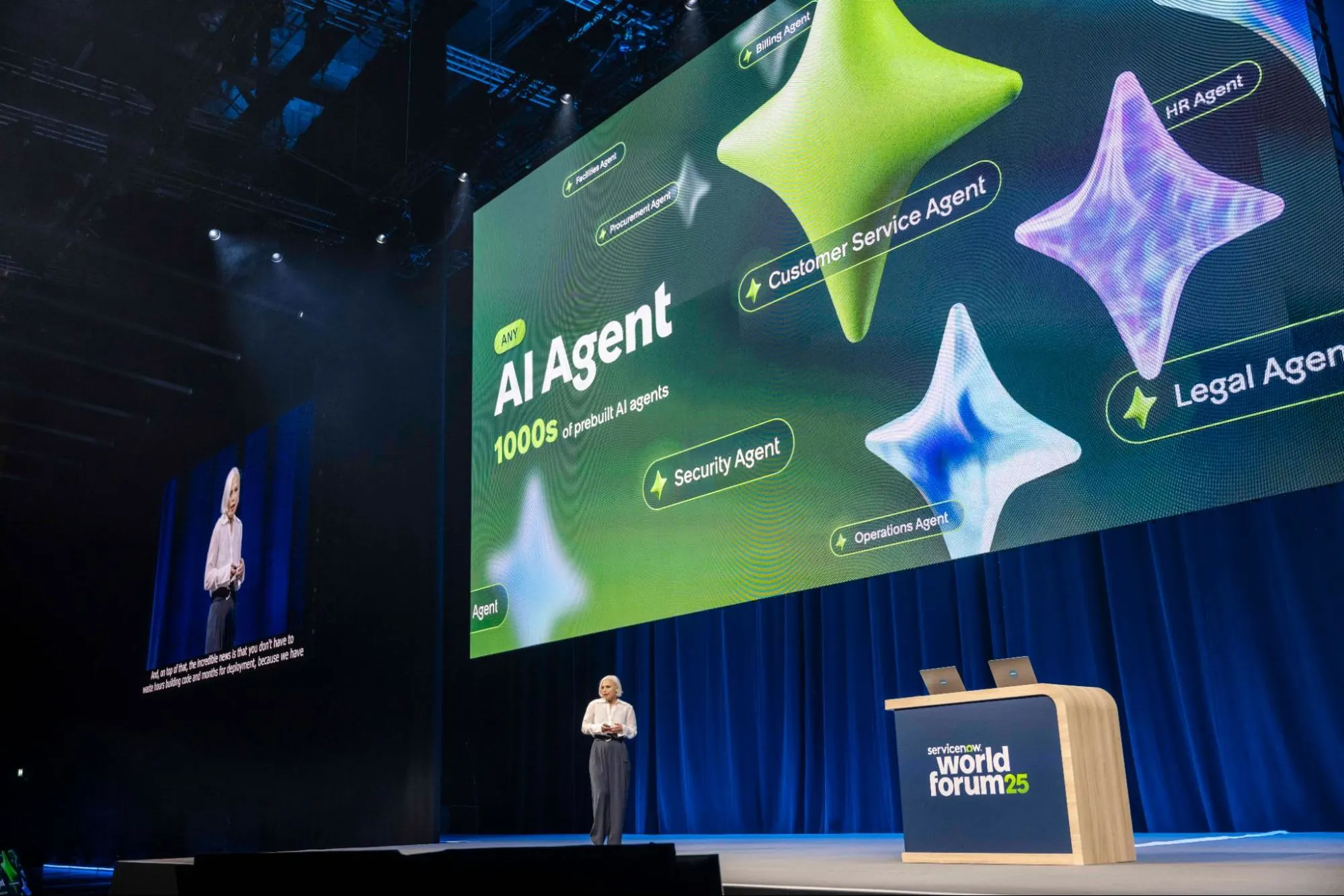
Elsewhere, Howson underscored the performance and protection spine of the Zurich release. “We’re supercharging the enterprise with a highly secure, scalable AI platform,” she said.
And while the keynote sped past product updates like Vault, Machine Identity Console, and developer sandboxes, there was a constant theme: unify data, keep context, and give agents read/write reach without breaking safety glass.
Tzitzon’s own platform verdict was unsurprisingly unambiguous: “The ServiceNow platform, after my long career in enterprise software, is by far the most flexible platform I’ve ever had the pleasure to work with.”
More than once, he repeated the line: “Any cloud, any AI, any data, any workflow for any industry.”

Final Thoughts
So, what does “beyond the headlines” of AI really mean to business leaders? According to ServiceNow, it is deciding in advance where you want revolution and where you want disciplined evolution. Then, create an architectural picture that is genuinely yours, where ServiceNow can be either the control tower and/or the experience layer, but not a bolt-on afterthought. Third, speaking plainly about jobs and trust, and how you frame change to the people who must live with AI.
In closing the keynote, Tzitzon said: “This is not about asking what AI can do, but what we want, asking people what they need from AI.”
In that sense, London served as a reminder that, regardless of the technology, the lesson is to put people at the center of the redesign.