





In the days and weeks after this year’s Knowledge Conference, headlines were particularly focused on several high-profile product announcements, including Apriel Nemotron 15B and the AI Control Tower. But now the dust has settled, we wanted to take a closer look at another announcement that flew somewhat under the radar at the time: The ServiceNow AI Platform.
According to ServiceNow, the AI Platform aims to “Put any AI, any agent, any model to work across the enterprise.” Of course, that sounds all well and good – but you could be forgiven for not quite understanding what it means in practice. If so, fear not, as here’s everything you need to know.
What Is the ServiceNow AI Platform – And What Does It Include?
“For decades, CEOs have wanted technology to accelerate the speed of business transformation. With this next-generation architecture, we finally have the foundation to run the integrated enterprise in real time.
“We are the only ones who can orchestrate AI, data, and workflows on a single platform. Now is the moment to unlock tomorrow’s opportunities with ServiceNow as the AI operating system of the 21st century.”
Bill McDermott, Chairman & CEO of ServiceNow
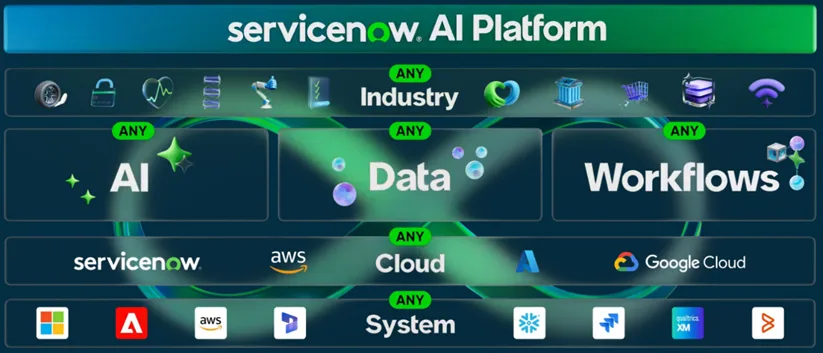
The ServiceNow AI Platform isn’t a defined product with its own license and dashboard. Instead, it’s better to consider this a loose grouping of different Agentic AI products, models, and communication layers – most of which were also announced at the Knowledge Conference this year.
From ServiceNow’s perspective, the logic of this announcement is clear: To bring together its disparate AI products under a common platform and brand identity, with AI at the forefront. We’ll discuss this strategy in more detail below. But first, let’s introduce the products that make up the platform.
1. AI Control Tower
The AI Control Tower is a centralized management console for disparate AI tools, providing visibility into AI performance, ROI, and governance. Unlike the AI Platform, the tool has a dedicated user interface and dashboard.
The goal is to help enterprises create a top-down view over all the AI agents in their organizations – including third-party products. This will enable customers to better understand how individual agents are being used, quantify the ROI, and enforce clear guardrails around how and where they’ll be used.
On the surface, this may sound quite similar to the AI Platform itself. But in reality, the focus is much narrower: management, compliance, and governance.
2. AI Agent Fabric
Also announced at Knowledge 2025, the AI Agent Fabric is a communication and integration layer for enterprise AI agents. To put that in simpler terms, it’s essentially a shared language that different AI agents use to communicate and share information.
Organizations are now increasingly investing in autonomous AI agents that are trained to complete a specific task or make a particular decision. The AI Agent Fabric aims to enable this new way of working, while avoiding the risk of siloed and conflicting decisions across different stages of a workflow.
To do this, it relies on two main protocols: Model Context Protocol (MCP) and Agent2Agent Protocol. It also includes a whole range of integrations with third-party cloud and AI vendors, including Microsoft, Google Cloud, Cisco, and more.
3. Workflow Data Fabric
Workflow Data Fabric is very similar to the AI Agent Fabric, but it specializes in data rather than AI Agents. It’s a behind-the-scenes infrastructure that connects enterprise data from different apps, systems, and sources. The goal is to help enterprises turn data from disparate sources into a coherent, AI-ready format.
To oversimplify, Workflow Data Fabric does for data what AI Agent Fabric does for AI agents. It’s not an AI tool in itself, but it’s about making it easier for organizations to build and train effective AI agents.
4. ServiceNow CRM
Given the name, it probably won’t surprise you much to hear that this is a new AI-powered CRM system. Unlike other tools on this list, this is a vertical AI application (i.e. designed for a specific use case) and doesn’t aim to coordinate multiple tools, agents, or systems.
The product aims to integrate traditional CRM functionality with new AI tools like intelligent routing, resolution, and agent assist features. Together, these tools will enable CS teams to deliver proactive, personalized, and automated customer experiences.
5. Apriel Nemotron 15
Apriel Nemotron 15B is a new enterprise-grade Agentic AI model, built by NVIDIA and trained on ServiceNow data. It joins an increasingly competitive market of Agentic AI models from other vendors, including QWQ-32b (Alibaba), EXAONE-32b (LG AI), and O1-mini (OpenAI). You can view an open-source version of the model on Hugging Face.
The model is optimized for workflow automation and domain-specific reasoning. In simple terms, that means it’s good at understanding context, solving complex problems, and making autonomous decisions.
Apriel Nemotron 15’s performance in these categories is very similar to the models we introduced above. But its real selling point is performance, since it uses roughly 50% of the processing power of these competitors. This is hugely important, because processing power (and by association, costs) is a significant operational barrier that prevents many organizations from using AI Agents at scale.
6. Knowledge Graph
The final entry onto this list was first announced in September last year and has been grouped under the ServiceNow AI Platform banner since the Knowledge Conference in May this year.
The product is essentially a semantic representation of enterprise entities and how they’re related, including people, tasks, documents, and systems. It aims to combine all this information together in a structured manner to help power more intelligent search results, recommendations, and decision-making from AI Agents.
In general, this isn’t a product that everyday ServiceNow users will interact with. Instead, it’s designed to enable other products, tools, and AI agents to better understand the rich context of your organization and the world you’re in.
Is the AI Platform Just a Brand Name?
We’re all ServiceNow superfans here, but even we have to admit that product releases in this ecosystem can be a somewhat confusing affair. This isn’t helped by the fact that Knowledge 2025 saw the announcement of several different tools and platforms with very similar names and product descriptions.
It would be easy to write off the AI Platform as largely a branding exercise. But, in reality, this would be an oversimplification. That’s because the products within it all clearly contribute to a shared vision and strategy for how ServiceNow expects AI to develop over the next few years.
Indeed, while the AI Platform isn’t a distinct product in itself, there are several things that the tools within it have in common:
- Agentic: The AI Platform tools focus specifically on Agentic AI, which ServiceNow increasingly sees as the next significant wave of AI innovation. This makes them distinct from the Generative AI tools that have gained headlines in recent years – many of which have also been integrated elsewhere in ServiceNow.
- Vendor-neutral: Despite being a ServiceNow offering, the explicit goal of the platform is to create a base of operations for as many disparate AI tools and agents as possible. As such, these products have wide compatibility with AI products from third-party vendors, as well as integrations with organizations like Accenture, Adobe, Box, Cisco, Google Cloud, IBM, Jit, Microsoft, Moonhub, RADCOM, UKG, and Zoom.
- Inter-agent: Much of the attention in the Agentic AI space is focused on individual agents designed for specific tasks. ServiceNow’s focus is much broader; it’s about enabling those agents to communicate and share information in a way that leads to effective automated workflows. As such, the ServiceNow AI Platform is much more focused on the communication between these tools than the underlying agents themselves.
- Operationalizing AI: While significant progress has been made on AI technology, there remain several operational challenges that prevent many enterprises from rolling it out at scale. These include the processing power of the underlying technology, as well as enabling inter-agent communication, and creating effective compliance and governance guardrails. The technology in ServiceNow’s AI Platform is uniquely focused on helping enterprises overcome these challenges.
So, while you might not be able to sign up for the ServiceNow AI Platform per se, it makes sense for ServiceNow to group them under a shared brand and vision.
Where Next for ServiceNow and AI?
As of today, most of the tools and products we’ve discussed on this list have been released for general availability. The only exception at this stage is AI Agent Fabric, which is currently available for early adopters and is expected to reach general availability in Q3 of this year. Since we’re already in Q3, we can expect updates at some point in the near future.
Nonetheless, we can absolutely expect new updates, announcements, and potentially even new products to be added to the ServiceNow AI Platform over the coming weeks and months. If and when they are, we’ll definitely be covering them in detail here first. In the meantime, watch this space.