


Before getting started, it’s worth noting that ServiceNow has very recently rebranded its AI Control Tower as SI Control Tower to reflect the shift to ‘super intelligence’. This means that some official documentation still refers to the former name, AI Control Tower, as do some of the explanations and images included in this guide, which will be updated as changes roll out across ServiceNow environments.
AI has rapidly become part of almost every enterprise, with organizations building their own AI solutions, adopting AI capabilities, and using AI from hyperscalers and other third-party platforms. But as the number of AI solutions grows, questions arise: How do you know which AI solutions exist across your organization? Who owns it? Where is it being used, and is it properly governed?
This is where ServiceNow SI Control Tower (SICT), formerly AI Control Tower, comes into the picture – described by ServiceNow as a control plane for discovering, governing, securing, observing, and measuring AI across the enterprise. It can provide visibility into ServiceNow and third-party AI assets, including AI deployed through hyperscalers, SaaS platforms, and development environments.
This guide will focus on the fundamentals of SI Control Tower, why organizations need it, how AI assets are discovered and added, their lifecycle, and the difference between managed and unmanaged AI assets.
What Is the SI Control Tower?
In simple terms, SI Control Tower provides a centralized inventory and governance layer for the AI being used across an organization.
Imagine an organization with thousands of AI Agents, LLM models, and datasets. Everything needs to be managed in one place, otherwise, nobody will have any idea what and where everything is hosted. Without a centralized view, these AI assets can easily become scattered across different teams and platforms.
SI Control Tower brings them into a common view. AI assets can be represented in the ServiceNow CMDB, giving them relationships with existing enterprise services, applications, and other configuration items.

Why Do We Need the SI Control Tower?
Let’s take an example of one team member building an AI agent. Another team starts using a model from a hyperscaler (such as Google or Microsoft Azure). Someone else then introduces an AI-enabled SaaS application. Over time, an organization can end up with hundreds of AI systems, models, datasets, prompts, and agents.
So, the problem isn’t necessarily the number of AI assets, but knowing what exists and how those assets are being used. For example, an organization may struggle to answer the following questions:
- Which AI assets are currently being used?
- Who owns them?
- What business purpose do they serve?
- What model or provider do they depend on?
- What data do they access?
- What risks are associated with them?
- Are they compliant with organizational policies?
- Which assets are no longer required?
SI Control Tower helps create this visibility and provides governance workflows around the AI portfolio. ServiceNow also supports discovery beyond ServiceNow itself through connectors for platforms such as AWS, Azure, and Google Cloud, with additional ecosystem integrations expanding over time.
The 5 Pillars of SI Control Tower

- Discover: Identify AI assets across the organization, including AI systems, models, agents, datasets, and other AI technologies from ServiceNow and external platforms.
- Govern: Manage the AI asset lifecycle by defining ownership, assessing risk, applying governance processes, and ensuring assets follow organizational policies.
- Secure: Protect AI assets by addressing security, access, privacy, and other security-related risks associated with AI usage.
- Observe: Gain visibility into how AI assets are being used and performing, helping teams monitor activity, behavior, and operational health.
- Measure: Understand the adoption, usage, performance, and business value of AI investments, helping organizations determine whether their AI initiatives are delivering the expected outcomes.
How Are AI Assets Added to SI Control Tower?
One of the most important concepts is AI asset discovery. AI assets can enter the inventory through different approaches.
1. ServiceNow AI Assets
AI capabilities created or deployed within the ServiceNow ecosystem can be represented in the SI Control Tower.
For example, an organization may have AI agents, Now Assist Skills, or other AI capabilities running within ServiceNow, and they can be discovered automatically and become part of the AI Inventory. The discovery job runs every six hours.
2. Hyperscaler and External AI Assets
Organizations may also run AI outside ServiceNow, like on Microsoft, Google, or Amazon. ServiceNow provides Service Graph Connectors and other integrations to discover AI assets across these environments. The available connectors continue to expand – recent ServiceNow updates added integrations including OpenAI, Anthropic, Moveworks, and Microsoft Agent 365.
3. Manual Discovery
Not every AI asset will necessarily be discovered automatically.
Organizations can also capture AI assets through manual processes when required. ServiceNow’s current guidance describes three discovery approaches: manual entry, automated discovery via Service Graph connectors, and identification of Shadow AI.
This is important because the goal is not simply to inventory the AI that IT knows about. The goal is to build a more complete picture of the organization’s AI landscape.
What Is an AI Asset?
An AI asset is essentially an AI-related technology or component that the organization wants to discover, track, and potentially govern.
Depending on the current SI Control Tower capabilities, this can include assets such as:
- AI Systems
- AI Models
- Datasets
- AI Agents
- Prompts
- MCP Servers
ServiceNow has continued expanding the inventory to cover additional AI asset types. For example, MCP servers are now tracked alongside models, agents, datasets, and prompts.
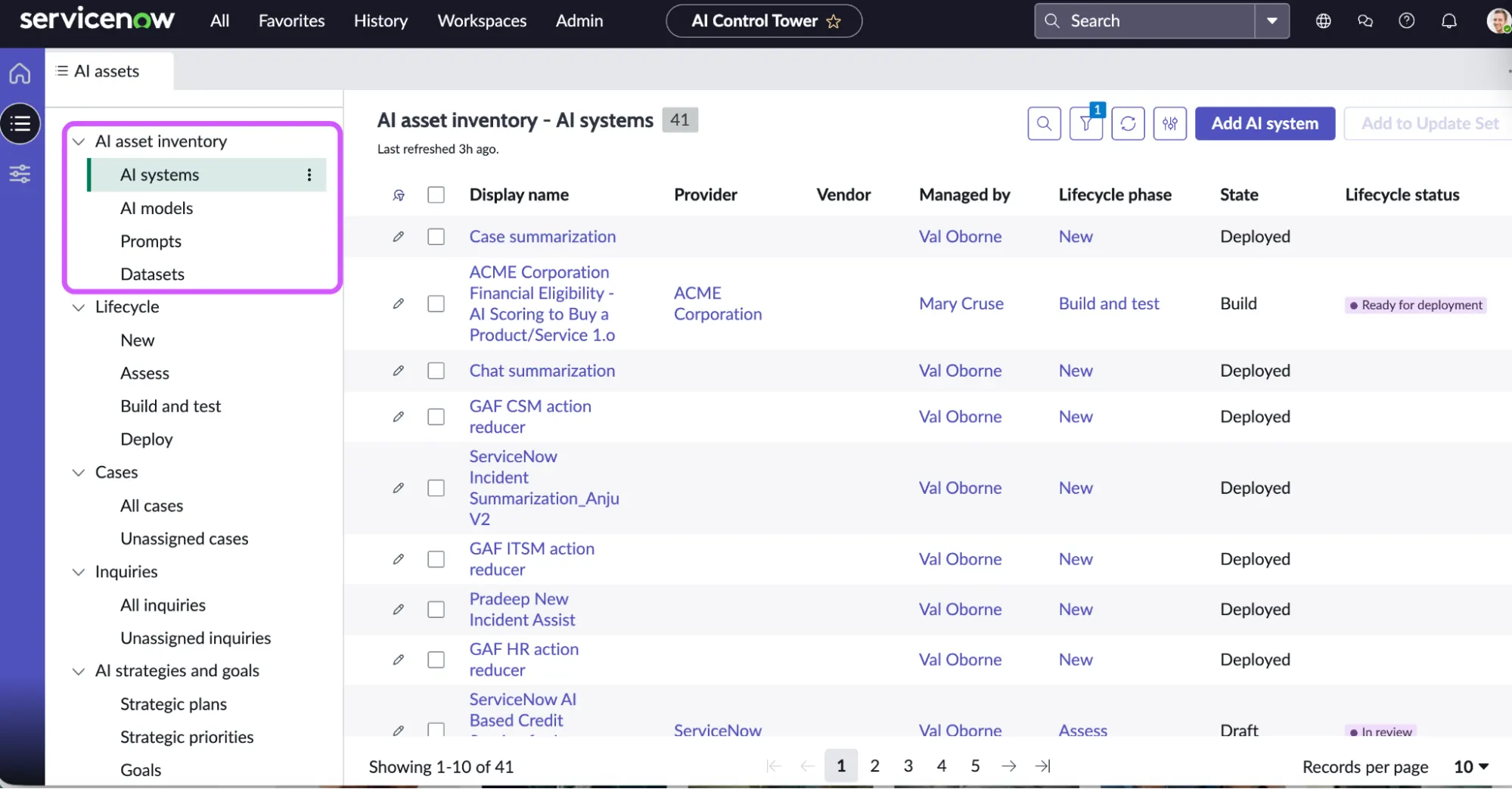
The important idea is that the SI Control Tower is not limited to tracking just an AI model. It can provide a broader view of the components that make up an AI ecosystem.
The AI Asset Lifecycle
Adding an AI asset to the inventory is only the beginning. AI assets need to be managed throughout their lifecycle. A simplified lifecycle can look like this: Assess → Build and Test → Deploy
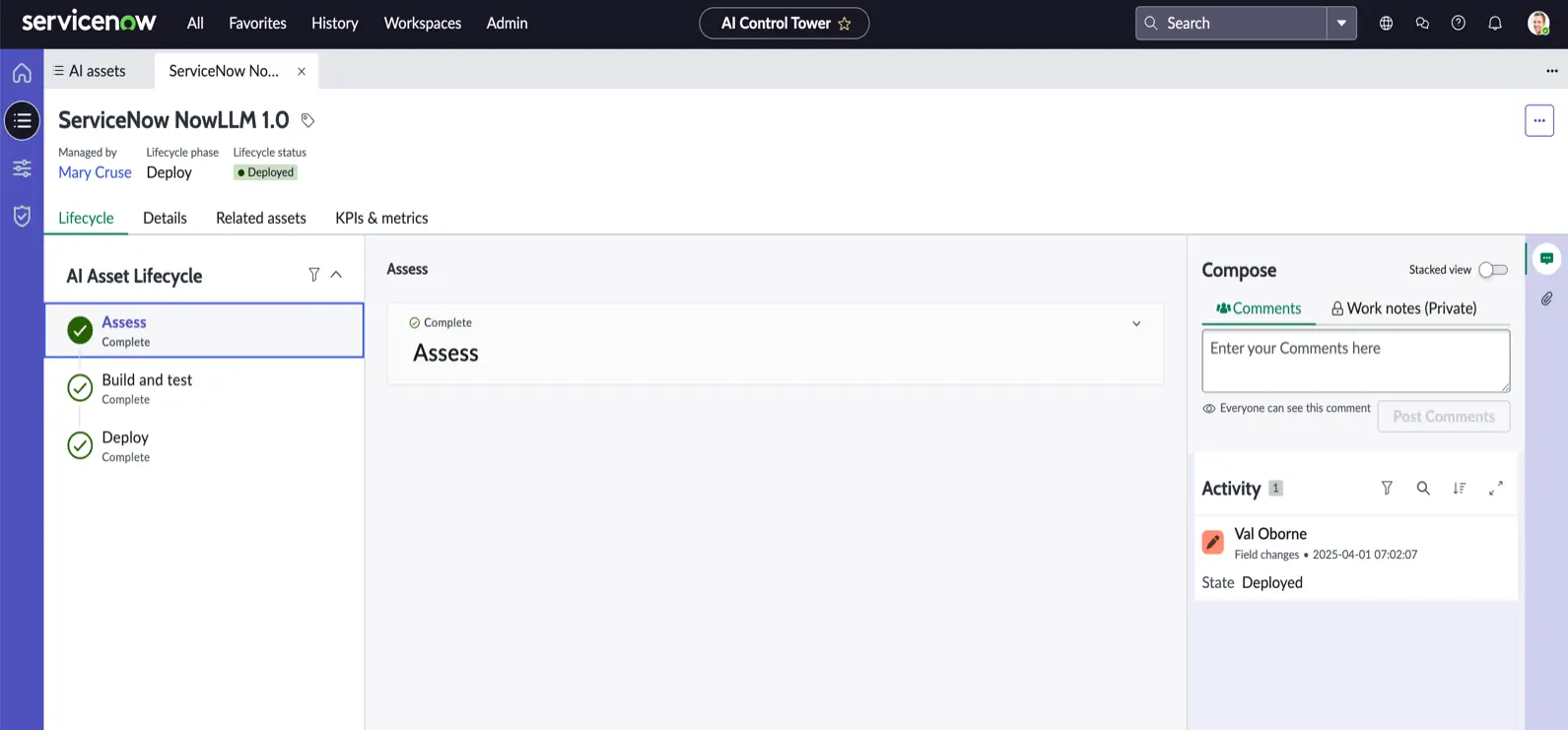
An AI asset doesn’t simply get added to the SI Control Tower and then remain static. ServiceNow provides a lifecycle process to take an AI asset from assessment through development and testing to deployment. The lifecycle is managed through tasks that can be assigned to the AI steward role.
1. Assess
The lifecycle starts with Assess. The AI steward reviews the asset and creates the required assessment tasks. These tasks can be assigned to the asset owner, who completes them before the asset moves to the next stage.
2. Build and Test
Once the assessment is completed, the asset moves to Build and Test. This stage includes activities such as creating the development plan and completing pre-deployment assessments before the AI solution is ready for production. The risks associated with these AI Agents are managed in the Integrated Risk Management application of ServiceNow.

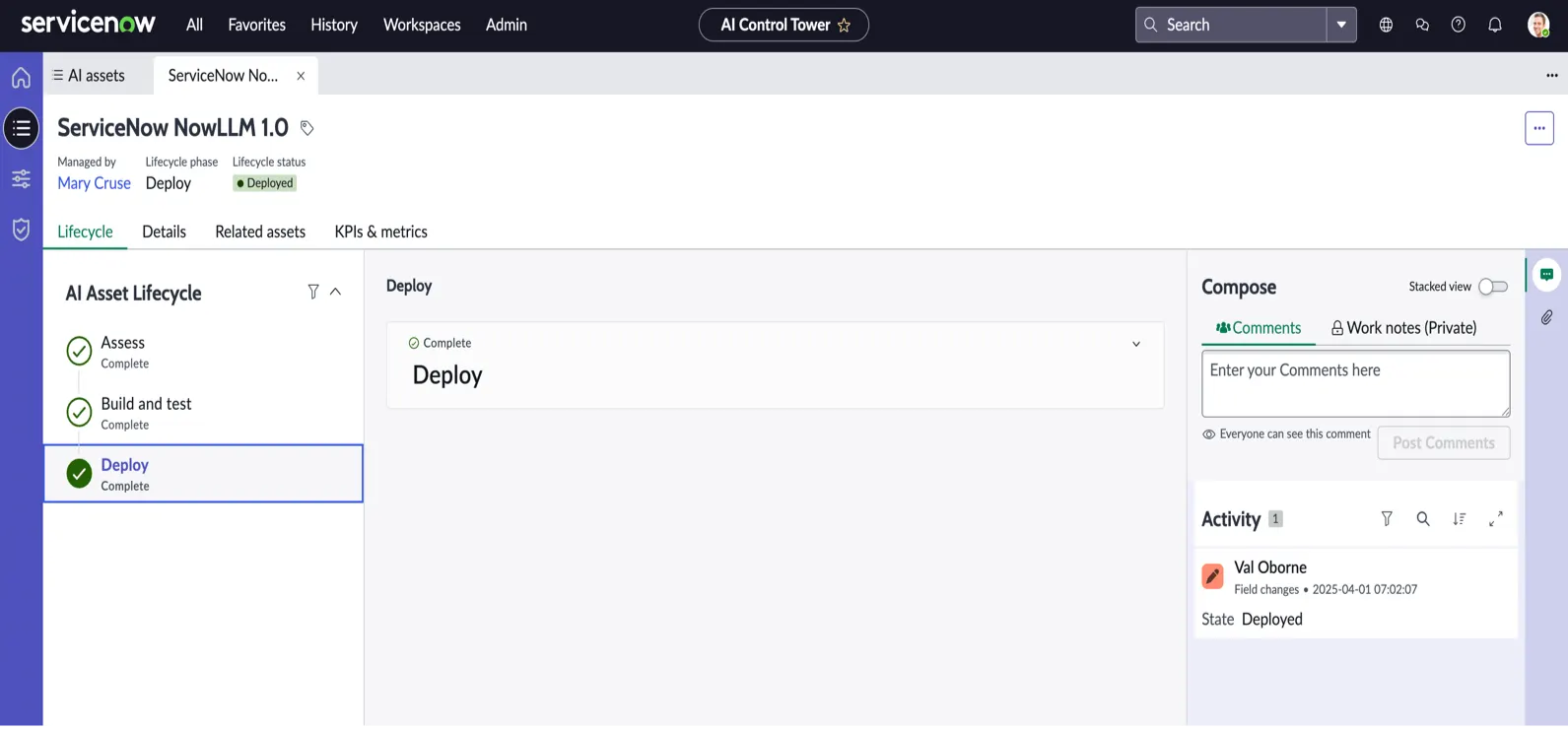
3. Deploy
The final stage is Deploy. Once the required tasks are completed, the AI asset can be deployed. The asset owner can complete the deployment task, after which the lifecycle status becomes Deployed and Completed.
Managed vs. Unmanaged AI Assets
This is another important concept in SI Control Tower. When an organization discovers a large number of AI assets, it may not want to immediately apply the full governance process to every asset. This is where Managed and Unmanaged states become useful.
Managed AI Assets
A Managed AI asset is brought under the organization’s active governance scope.
Depending on the configuration and capabilities enabled, managed assets can have governance workflows, risk assessments, value measurement, and monitoring applied to them. Also, as of now, you have to pay ServiceNow for every Managed AI Asset.
For example, a production AI agent that processes sensitive business information may be classified as Managed and subjected to the organization’s governance processes.
Unmanaged AI Assets
An Unmanaged AI asset can still be visible in the broader AI inventory, but it is not currently within the active governance scope. The Unmanaged AI Assets are just the plain, simple records sitting in the AI Asset inventory.
This can be useful when an organization discovers a large number of assets and needs to prioritize which ones should go through governance first.
For example: An organization discovers 500 AI assets across different platforms. It may initially identify 100 business-critical or higher-risk assets as Managed while maintaining visibility of the remaining assets as Unmanaged.
We can keep all retired AI assets as unmanaged assets, since they don’t need any governance but are still required for the audits.
ServiceNow’s current functionality allows assets to be explicitly designated as Managed or Unmanaged, while preserving historical data and audit information when an asset exits active governance.
Also, you can write automated rules to make an AI asset Managed or Unmanaged.
From AI Inventory to AI Governance
The SI Control Tower is more than just an inventory tool. Once AI assets are discovered, organizations can start connecting them to:
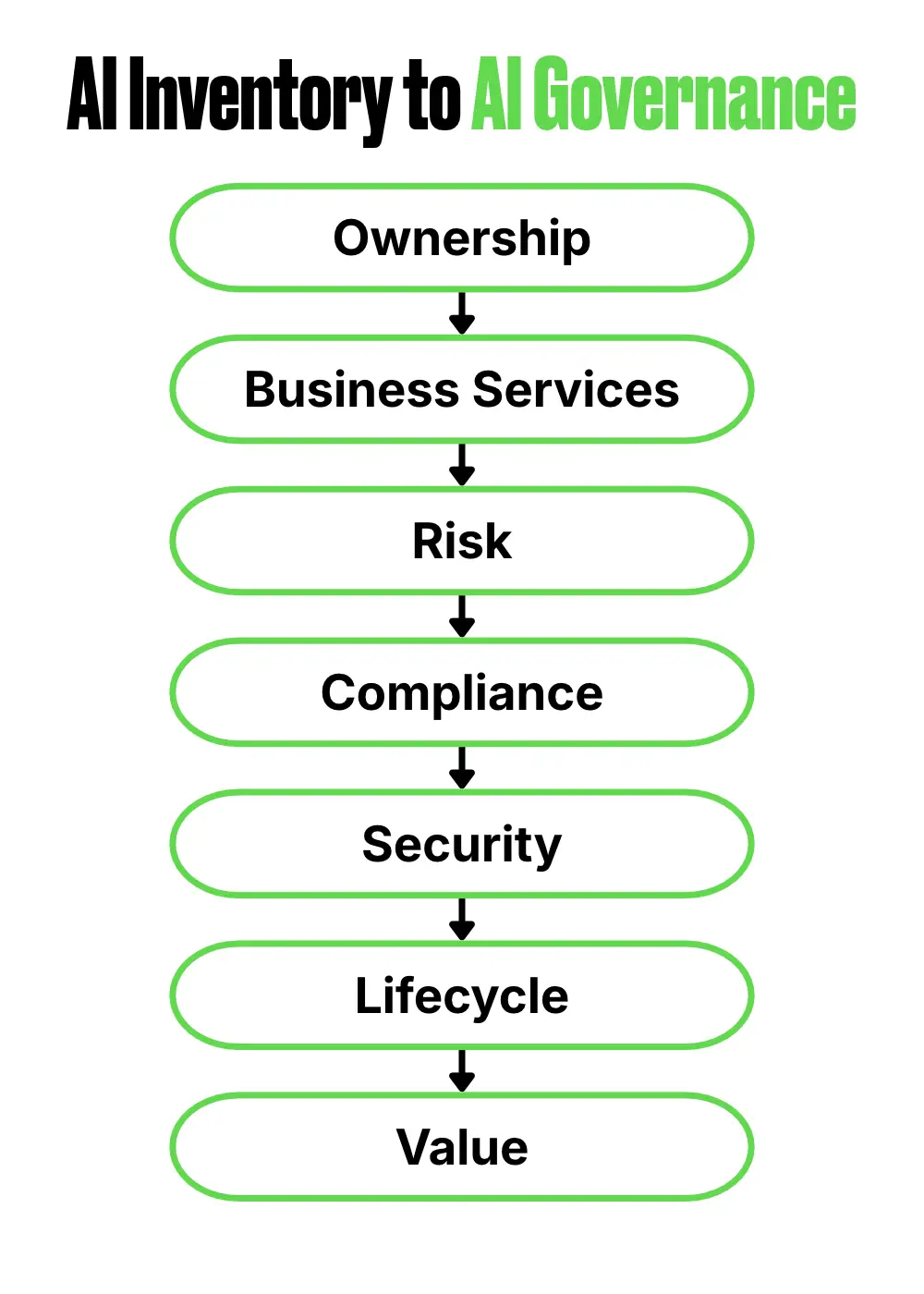
For example, imagine an AI agent used by a bank’s customer-service team. SI Control Tower can help the organization understand:
- What is it? An AI agent.
- Who owns it? The customer-service product owner.
- Where does it run? ServiceNow.
- What does it depend on? Specific models, data, prompts, or other AI components.
- What risk does it introduce? Potential data privacy, security, or regulatory risk.
- What controls apply? The organization’s AI governance and security controls.
- Is it delivering value? Adoption and business-value metrics can be tracked.
This creates a much more complete picture of the AI asset.
How to Plan Your Organization’s Implementation of SI Control Tower
A practical approach to implementing SI Control Tower is to start with the AI assets already available within ServiceNow, establish the governance process, and then gradually expand visibility to external AI platforms.
1. Start With ServiceNow AI Assets
Begin by enabling the discovery of AI assets within ServiceNow. Rather than manually creating the inventory, let SI Control Tower identify the available ServiceNow AI assets.
Review the discovered assets, validate their information, identify their owners, and bring the relevant assets under the organization’s governance process.
2. Take the Assets Through Their Lifecycle
Once the ServiceNow AI assets are discovered, manage them through the SI Control Tower lifecycle: Assess → Build and Test → Deploy
Use this stage to understand how the governance process works, validate assessments and approvals, and establish ownership and accountability.
3. Validate the Governance Model
Before expanding outside ServiceNow, use the initial implementation to validate:
- AI asset ownership
- AI Steward responsibilities
- Risk and assessment processes
- Governance approvals
- Lifecycle tasks
- Managed vs. unmanaged assets
- Reporting and visibility
This gives the organization a working governance model before introducing additional AI sources.
4. Expand to Hyperscalers
Once the ServiceNow AI assets are successfully managed, start connecting external AI platforms such as AWS, Microsoft Azure, and Google Cloud.
The objective is to gradually expand: ServiceNow AI Assets → Hyperscaler AI Assets → Broader Enterprise AI Landscape
5. Build Enterprise-Wide AI Visibility
As additional sources are connected, SI Control Tower can become the central inventory for the organization’s AI landscape.
The long-term goal is: Discover AI everywhere → Bring visibility into one place → Assess risk → Apply governance → Manage the lifecycle → Measure value.
My Personal Take
For me, this is where the SI Control Tower becomes particularly interesting. We’ve spent years building CMDBs to understand our applications, infrastructure, services, and their relationships. Now AI is becoming another important part of the technology landscape. I see SI Control Tower as bringing that same enterprise-management mindset to AI.
The interesting part isn’t simply having a list of AI agents or models. The real value goes beyond having a list of AI agents or models to connecting those AI assets to the rest of the enterprise.
If I can discover an AI asset, understand who owns it, see what business service it supports, assess its risk, apply governance, monitor it, and eventually retire it in one platform, it will create a complete operating model for AI. And as organizations move from a handful of AI experiments to hundreds or thousands of AI assets, this kind of visibility becomes increasingly important.
Final Thoughts
AI adoption is moving quickly, and organizations are likely to have AI coming from many different sources. The Super Intelligence Control Tower (formerly AI Control Tower) provides a way to bring that growing AI landscape into a centralized inventory and governance framework.
And the distinction between Managed and Unmanaged AI assets allows organizations to prioritize governance while maintaining visibility into the broader AI landscape.
Ultimately, SI Control Tower is about moving from simply using AI to knowing what AI you have, where it is being used, who owns it, the risks it creates, and how it is being managed.