





For many professionals, the ServiceNow job market likely feels like a bustling space full of opportunities, especially compared to other software that might have varying levels of demand. After all, with a near 23% growth YoY, it’s easy to see why.
However, markets are turbulent, and even strong financial results do not guarantee an equally bountiful job market. So, is ServiceNow’s current hiring landscape proficient enough for the avid tech job seeker, or have the first signs of saturation begun to seep through?
The ServiceNow Job Market, 2020-2025
The last five years have been eventful for the ITSM leader, with 2020 kicking off a year of rapid adoption thanks to the rise of COVID-era remote working and digital transformation efforts. In fact, ServiceNow’s CEO, Bill McDermott, stated that 2020 was a year that ServiceNow “beat expectations across the board” – it was the perfect time for businesses to be honing in on their ITSM implementation efforts.
“The secular tailwinds of digital transformation, cloud computing, and business model innovation have all intersected at the perfect moment in time,” he said.
A successful 2020 led to a surge in hiring, bringing ServiceNow’s employee numbers from 13,000+ people by the end of 2020 to just under 17,000 employees by the end of 2021. In 2021, ServiceNow also reported that employee growth in the UK had reached 18.6%, signalling further that the pandemic tech trends were having an increasingly positive impact on the company’s hiring practices.

However, come 2022, the first signs of the market changing were becoming apparent. Although ServiceNow was growing at a rate of ~30% annually and with a steady group of over 7,500 customers, the attitude to hiring changed. No longer in such a heavy pursuit of entry-level roles, the focus shifted to mid-level and senior positions – the professionals who could guide businesses in more dynamic directions – an important skill for the post-COVID tech landscape.
A commenter on Reddit shared their experience of the time, saying that a common theme if you have the experience, is to get approached by consultancies.
“I get approached by recruiters on LinkedIn on a regular basis looking to fill roles at consultancies,” they wrote. “When I last changed jobs in May 2022, they were really struggling to fill in-house positions as the good candidates were getting snapped up by consultancies.”
2022’s employee numbers reached around 20,400 despite these changes.
In 2023, the upward hiring trend was not as pronounced, with employee numbers now reaching 22,600. However, this is not to say that ServiceNow began struggling – in fact, ServiceNow users were reportedly “going all in on their ServiceNow investments” that year, with a 26% increase in revenue.
Come 2024, and the rise of AI began affecting every corner of the tech industry, reshaping the way SaaS businesses like ServiceNow functioned. Although ServiceNow finished the year with a slightly lower-than-previous 21% YoY growth rate, it exceeded Q4 expectations and began “building on its leadership position in AI”, with several new AI products and enhancements, including the AI Agent Orchestrator and AI Agent Studio.
ServiceNow rounded off the year with just under 26,300 employees, a more complex instance UI, and a rising demand for multi-purpose, skilled professionals.
What Does the Job Market Look Like in 2025?
Fast forward to 2025, and the current ServiceNow job market seemingly presents more questions than it does answers. For one, the company’s Q2 2025 earnings results signalled success with a 22.5% YoY growth and the continuation of a persevering track record, it announced expansion plans at this year’s flagship Knowledge conference, and it has just invested $1.5B into AI cloud company Genesys – all clear indicators of strong performance.
Analysts have predicted a notable surge in demand for ServiceNow professionals in 2025 for a while now, but this doesn’t necessarily mean that the hiring landscape is or will be easy to navigate.
A Reddit thread from earlier this year highlighted how seemingly frustrating the job market currently is for entry-level professionals, with the original poster highlighting his struggles, especially when it came to job demands.
“Most of these positions require at least 3 years of experience for an entry-level job, which I obviously don’t have,” they wrote. “It’s kind of brutal out here, to be honest.”
“I have 10 years of experience, and it took me 13 months to land a job,” another commenter added, signifying that the problem may not just be limited to industry newbies.
There have also been implications that there is a disconnect between hiring managers and professionals right now, with professionals looking for high-tech salaries that have been promised in the stars since forever, and hiring managers not meeting rising expectations. Others have also shared that they routinely get interviews, but never seem to get past the interviews.
Another commenter on the thread shared their experience of this, saying: “I get a lot of applications from people who are beginning their ServiceNow Developer journey but asking for Senior Developer level pay.”
Addressing the Disconnect
According to ServiceNow recruiting agency Nelson Frank, who has worked with over 30,000 organizations, there are over 900 ServiceNow job seekers, and they see over 2,000 new ServiceNow professionals every year.
A 2023 survey conducted by the company also provided a lot of further insights into the world of ServiceNow hiring, including the fact that 84% of ServiceNow professionals consider experience the most important factor in increasing their earning potential.
70% of hiring managers believe that a skills gap in the ServiceNow community is a prominent issue, and 51% revealed that finding the right talent – and the time it takes to do so – is the biggest challenge they face in overcoming the skills gap.
“It’s clear that the ServiceNow talent market is facing a significant supply and demand problem,” the report says. “With ServiceNow leading the charge on creating new talent to service its growing ecosystem, we’ll hopefully see an uptick in qualified candidates joining the ServiceNow field in the next few years.”
“I did a string of interviews last year; my company interviewed about 10-12 candidates and hired three of them,” a poster on another Reddit thread commented. “I would get candidates who worked at a place for a few years, but had a hard time articulating what they did.”
“Their resumes looked good, they knew all of the “this is how a client script works” or “this is how a business rule works,” but when it came to actual practical examples, it seemed like they couldn’t explain how they used client scripts or business rules in the projects that they worked on or what they actually built.”
A hiring manager agreed with similar sentiments, saying that they looked for people who could “tell [them] great stories.”
“The tech know-how is great… but tell us how you saved a company money, increased security, automated manual tasks, managed challenging assets, and integrated with X, Y, and Z products. Back up your tech work with their positive outcomes and benefits.”
Saturation or Shifting Expectations?
Changes in hiring demands and a probable disconnect between professionals and recruiters doesn’t necessarily signal saturation, but to get a clearer picture, I sat down with Erik Gunther, a ServiceNow Solution Architect, Program Manager, and founder of Devpivot.io – a company that focuses on delivering ServiceNow training and mentoring.
Gunther said that a big reason he chose to start DevPivot was the fact that he recognized the need for training that goes beyond technical skills, focusing instead on solution design and practical application. Erik’s coaching approach, embodied in DevPivot, emphasizes a “sweet spot” for success in the ServiceNow platform, combining technical ability, service management principles, and domain knowledge.
When I mentioned that I had been seeing that people were getting interviews but not often being hired, a big reason behind this seemed to be a difficulty in explaining practical knowledge – not just surface-level knowledge.
“I built a course on exactly that,” he told me. “Unfortunately, employers are looking for people that are more experienced. They’re either very strong technically or have a lot of domain knowledge, but they need to be both.”
“There are some core capabilities knowledge from the fundamental certifications [in my interview prep course] – let’s remind ourselves that these are the core skills. But, I’m not going to teach you these here – I’m just going to expose you to it so you remember it in the interview and instead focus on how to demonstrate these cross-functional skills and tell your story.”
From Gunther’s experience with the people he coached, the real value came from being able to learn how to make knowledge, skills, and experience applicable, highlighting to employers that you understand the why as well as the how.
When asked whether he thought the market was becoming saturated, he was quick to assure that that was unlikely.
“I don’t think it’s saturated because the growth of the platform is phenomenal,” he said.
The case instead is likely this: like many other adjacent softwares, employers now have the opportunity to be choosy. IT budgets are being funneled into AI, SaaS customer demands are changing, and hiring is still likely happening at a stable rate within the market, but with an increased focus on hiring deeply technical, adaptable talent.
4 Tips for Professionals
There isn’t just one magic answer to succeeding in the ServiceNow space or the job market in 2025, but there are some empirical steps that professionals can take to secure a fighting chance.
Get Certified
Gunther emphasised the importance (and necessity) of having a Certified System Administrator (CSA) certification when starting out, as this is the base of the foundational knowledge that professionals will not only need, but that employers will be looking for too.
There’s data to back this up, too – according to Nelson Frank’s Hiring Guide, 82% of professionals believe certifications increase your value as a candidate, and professionals also reported an average post-certification salary boost of 31%.
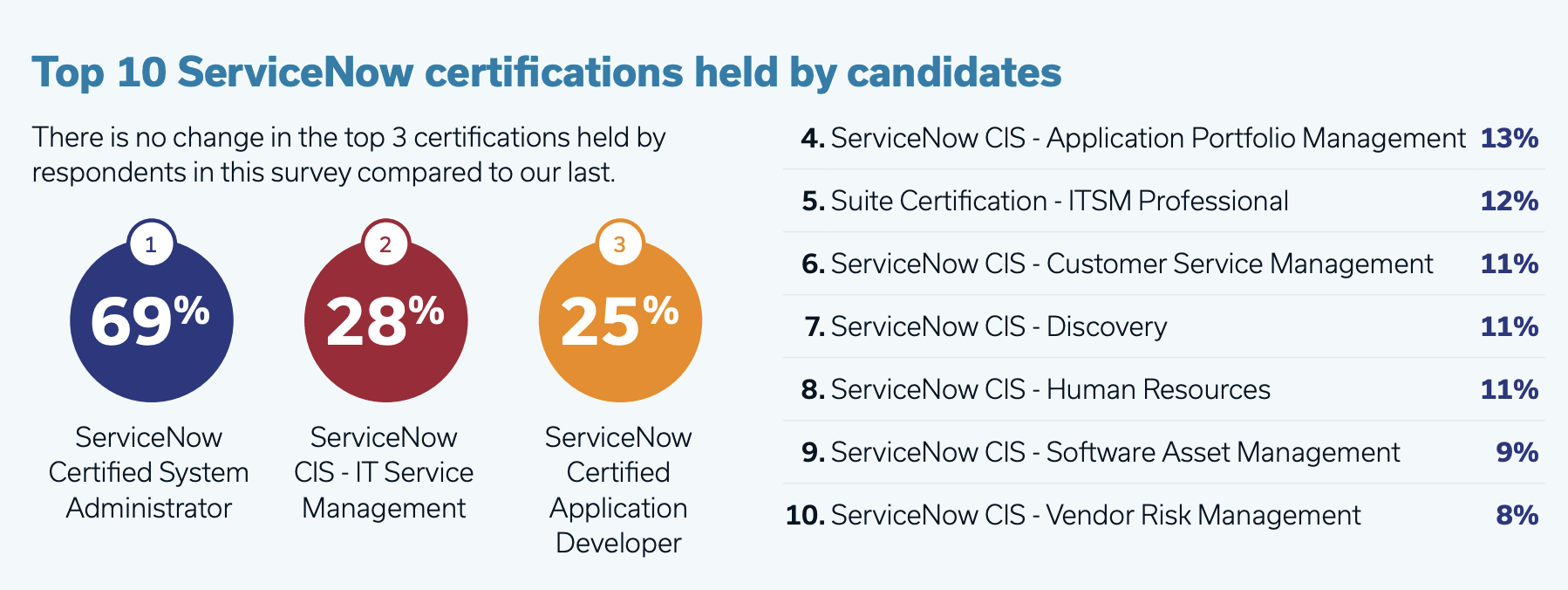
If you’ve been in the Now community for a while and need a new way up, building up knowledge and getting certified in ITOM (IT Operations Management) or DEX (Digital End User Experience) have both been cited as potentially lucrative paths.
Think Practically, Not Just Technically
As Gunther shared, the key to being what a ServiceNow recruiter is looking for right now is understanding how to apply technical knowledge to practical business use cases.
Now more than ever, employers are eager to know how you can help them, their instances, and their companies, so being able to confidently use your knowledge to present solutions to common business challenges will help you stand out from the crowd.
Find a Mentor
You might be wondering: “how do I actually build upon that skill?” Well, mentoring is a really good place to start.
Finding a ServiceNow mentor to help you tackle prospective business challenges practically, prepare for interviews, and get a better understanding of the market will be invaluable to any professional, but especially entry-level ones. This could be a specialized mentor or just someone who’s already working in the field who is willing to guide you.
If you can, practice with them – build small projects, take up some volunteering work, and continuously build upon the certification knowledge.
Lean Into AI
Lastly, AI innovation is very much here to stay, and it has quickly become a core part of ServiceNow’s mission and efforts.
The whole “get with it or get left behind” mentality arguably might not be as strong with ServiceNow as it is with other tech businesses or spaces, but it’s still something that Bill McDermott backs fully, calling it “civilization’s greatest opportunity of this century”.
If you haven’t already, get stuck in with learning and training on ServiceNow University, ensuring you understand how some of ServiceNow’s top AI products and features work, and how AI can make a whole host of business processes more efficient.
Final Thoughts
So, is the ServiceNow job market saturated? I would say not.
The hiring demands of the market have undoubtedly changed as it has matured and shifted to head in new directions and meet new goals, but the demand for talent is still very much there.
Professionals should now be aware that employers are looking for a specific kind of employee – one that can apply technical knowledge to practical use cases, and think beyond the certification exam.